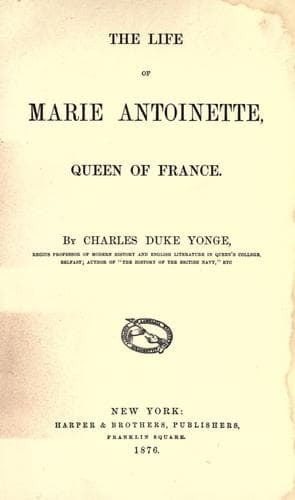
The Life of Marie Antoinette, Queen of FranceYonge, Charles Duke
History
The Life of Marie Antoinette, Queen of France
Yonge, Charles Duke
Marie Antoinette, Queen, consort of Louis XVI, King of France, 1755-1793
A more unhappy choice could not possibly have been made. The new minister
was soon seen to be as devoid of information and ability as he was known
to be of honesty. He had a certain gravity of outward demeanor which
imposed upon many, and he had also the address to lead the conversation to
points which, his hearers understood still less than himself; dilating on
finance and the money market even to the ladies of the court, who had had
some share in persuading the queen of his fitness for office.[11] But his
disposition was in reality as rash as that of Calonne; and it was a
curious proof of his temerity, as well as of his ignorance of the feeling
of parties in Paris, that though he knew the Notables to be friendly to
him, as indeed they would have been to any one who might have superseded
Calonne, he dismissed them before the end of the month. And the language
held on their dissolution both by the ministers and by the President of
the Notables, and which was cheerfully accepted by the people, is
remarkable from the contrast which it affords to the feelings which swayed
the national council exactly two years afterward. Some measures of
retrenchment which the Notables had recommended had been adopted; some
reductions had been made in the royal households; some costly ceremonies
had been abolished; and one or two imposts, which had pressed with great
severity on the poorer classes, had been extinguished or modified. And not
only did M. Lamoignon, the Keeper of the Seals, in the speech in which he
dismissed them, venture to affirm that these reductions would be found to
have effected all that was needed to restore universal prosperity to the
kingdom; but the President of the Assembly, in his reply, thanked God "for
having caused him to be born in such an age, under such a government, and
for having made him the subject of a king whom he was constrained to
love," and the thanksgiving was re-echoed by the whole Assembly. But this
contentment did not last long. The embarrassments of the Treasury were too
serious to be dissipated by soft speeches. The Notables were hardly
dissolved before the archbishop proposed a new loan of an enormous amount;
and, as he might have foreseen, their dissolution revived the pretensions
of the Parliament. The queen's description of the rise of a French
opposition at once received a practical commentary. The debates in the
Parliament became warmer than they had ever been since the days of the
Fronde: the citizens, sharing in the excitement, thronged the palace of
the Parliament, expressing their approval or disapproval of the different
speakers by disorderly and unprecedented clamor; the great majority
hooting down the minister and his supporters, and cheering those who spoke
against him. The Duc d'Orléans, by open bribes, gained over many of the
councilors to oppose the court in every thing. The registration of several
of the edicts which the minister had sent down was refused; and one member
Public-domain text, read in full here on John Shaqi.
Reviews
Reviews
No reviews yet
Be the first to share your thoughts on this work.
Elsewhere in the archive
Join the Discussion
Join the discussion
Sign in to leave a comment or review.
Sign InorCreate an account