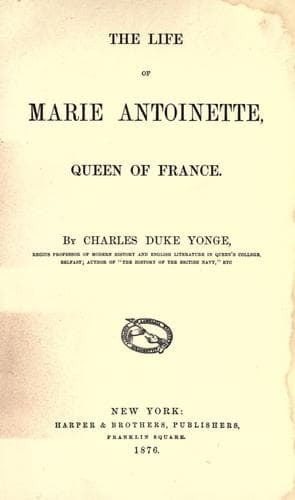
The Life of Marie Antoinette, Queen of FranceYonge, Charles Duke
History
The Life of Marie Antoinette, Queen of France
Yonge, Charles Duke
Marie Antoinette, Queen, consort of Louis XVI, King of France, 1755-1793
of the Orleanist party even demanded the convocation of the States-
general, formerly and constitutionally the great council of the nation,
but which had never been assembled since the time of Richelieu.
The archbishop was sometimes angry, and sometimes terrified, and as weak
in his anger as in his terror. He persuaded the king to hold a bed of
justice to compel the registration of the edicts. When the Parliament
protested, he banished it to Troyes. In less than a month he became
alarmed at his own vigor, and recalled it. Encouraged by his
pusillanimity, and more secure than ever of the support of the citizens
who had been thrown into consternation by his demand of a second loan,
nearly[12] six times as large as the first, it became more audacious and
defiant than ever, D'Orléans openly placing himself at the head of the
malcontents. Loménie persuaded the king to banish the duke, and to arrest
one or two of his most vehement partisans; and again in a few weeks
repented of this act of decision also, released the prisoners, and
recalled the duke.
As a matter of course, the Parliament grew bolder still. Every measure
which the minister proposed was rejected; and under the guidance of one of
their members, Duval d'Esprémesnil, the councilors at last proceeded so
far as to take the initiative in new legislation into their own hands. In
the first week in May, 1788, they passed a series of resolutions affirming
that to be the law which indeed ought to have been so, but which had
certainly never been regarded as such at any period of French history. One
declared that magistrates were irremovable, except in cases of misconduct;
another, that the individual liberty and property of every citizen were
inviolable; others insisted on the necessity of convoking the States-
general as the only assembly entitled to impose taxes; and the councilors
hoped to secure the royal acceptance of these resolutions by some previous
votes which asserted that, of those laws which were the very foundation of
the Constitution, the first was that which assured the "crown to the
reigning house and to its descendants in the male line, in the order of
primogeniture.[13]"
Public-domain text, read in full here on John Shaqi.
Reviews
Reviews
No reviews yet
Be the first to share your thoughts on this work.
Elsewhere in the archive
Join the Discussion
Join the discussion
Sign in to leave a comment or review.
Sign InorCreate an account