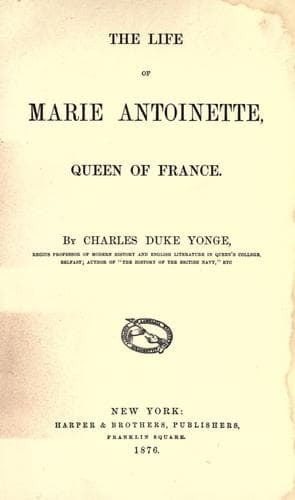
The Life of Marie Antoinette, Queen of FranceYonge, Charles Duke
History
The Life of Marie Antoinette, Queen of France
Yonge, Charles Duke
Marie Antoinette, Queen, consort of Louis XVI, King of France, 1755-1793
But Louis, or rather his rash minister, was not to be so conciliated; and
a scene ensued which is the first of the striking parallels which this
period in France affords to the events which had taken place in England a
century and a half before. As in 1642 Charles I. had attempted to arrest
members of the English Parliament in the very House of Commons, so the
archbishop now persuaded Louis to send down the captain of the guard, the
Marquis d'Agoust, to the palace of the Parliament, to seize D'Esprémesnil,
and another councilor named Montsabert, who had been one of his foremost
supporters in the recent discussions. They behaved with admirable dignity.
Marie Antoinette was not one to betray her husband's counsels, as
Henrietta Maria had betrayed those of Charles. D'Esprémesnil and his
friend, wholly taken by surprise, had had no warning of what was designed,
no time to withdraw, nor in all probability would they have done so in any
case. When M. d'Agoust entered the council hall and demanded his
prisoners, there was a great uproar. The whole Assembly made common cause
with their two brethren who were thus threatened. "We are all
d'Esprémesnils and Montsaberts," was their unanimous cry; while the tumult
at the doors, where a vast multitude was collected, many of whom had arms
in their hands and seemed prepared to use them, was more formidable still.
But D'Agoust, though courteous in the discharge of his duty, was intrepid
and firm; and the two members voluntarily surrendered themselves and
retired in custody, while the archbishop was so elated with his triumph
that a few days afterwards he induced the king to venture on another
imitation of the history of England, though now it was not Charles, but
the more tyrannical Cromwell, whose conduct was copied. Before the end of
the month the Governor of Paris entered the palace of the Parliament,
seized all the registers and documents of every kind, locked the doors,
and closed them with the king's seal; and a royal edict was issued
suspending all the parliaments both in the capital and the provinces.
CHAPTER XXII.
Formidable Riots take place in some Provinces.--The Archbishop invites
Necker to join his Ministry.--Letter of Marie Antoinette describing her
Interview with the Archbishop, and her Views.--Necker refuses.--The Queen
sends Messages to Necker.--The Archbishop resigns, and Necker becomes
Minister.--The Queen's View of his Character.--General Rejoicing.--Defects
in Necker's Character.--He recalls the Parliament.--Riots in Paris.--
Severe Winter.--General Distress.--Charities of the King and Queen.--
Gratitude of the Citizens.--The Princes are concerned in the Libels
published against the Queen.--Preparations for the Meeting of the States-
general.--Long Disuse of that Assembly.--Need of Reform.--Vices Of the Old
Feudal System.--Necker's Blunders in the Arrangements for the Meeting of
the States.--An Edict of the King concedes the Chief Demands of the
Commons.--Views of the Queen.
Public-domain text, read in full here on John Shaqi.
Reviews
Reviews
No reviews yet
Be the first to share your thoughts on this work.
Elsewhere in the archive
Join the Discussion
Join the discussion
Sign in to leave a comment or review.
Sign InorCreate an account