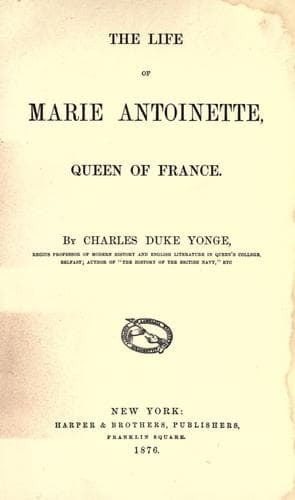
The Life of Marie Antoinette, Queen of FranceYonge, Charles Duke
History
The Life of Marie Antoinette, Queen of France
Yonge, Charles Duke
Marie Antoinette, Queen, consort of Louis XVI, King of France, 1755-1793
Neither the queen's feelings nor her conduct had been in any way altered;
but six months later the same populace who raised this monument and
applauded these verses were, with ferocious and obscene threats, clamoring
for her blood. And there is hardly any thing more strange or more grievous
in the history of the nation, hardly any greater proof of that incurable
levity which was one great cause of the long series of miseries which soon
fell upon it, than that the impressions of gratitude which were so vivid
at the moment, and so constantly revived by the queen's untiring
benevolence, could yet be so easily effaced by the acts of demagogues and
libelers, whom the people thoroughly despised even while suffering
themselves to be led by them. How great a part in these libels was borne
by those who were bound by every tie of blood to the king to be his
warmest supporters, we have a remarkable proof in an Edict of Council
which was issued during the ministry of the archbishop, and which deprived
the palaces of the Count de Provence, the Count d'Artois, and the Duc
d'Orléans of their usual exemption from the investigation of the syndics
of the library, as those officers were called whose duty it was to search
all suspected places for libelous or seditious pamphlets; the reason
publicly given for this edict being that the dwellings of these three
princes were a perfect arsenal for the issue of publications contrary to
the laws, to morality, and to religion.[11]
With the return of spring, the severity of the distress began to pass
away. But, even while it lasted, it scarcely diverted the attention of the
middle classes from the preparations for the approaching meeting of the
States-general, from which the whole people, with few exceptions, promised
themselves great advantages, though comparatively few had formed any
precise notion of the benefits which they expected, or of the mode in
which they were to be attained. The States-general had been originally
established in the same age which saw the organization of our own
Parliament, with very nearly the same powers, though the members had more
of the narrower character of delegates of their constituents than was the
case in England, where they were more wisely regarded as representatives
of the entire nation.[12] And it was an acknowledged principle of their
constitution that they could neither propose any measure nor ask for the
redress of any grievance which was not expressly mentioned in the
instructions with which their constituents furnished them at the time of
their election.
Public-domain text, read in full here on John Shaqi.
Reviews
Reviews
No reviews yet
Be the first to share your thoughts on this work.
Elsewhere in the archive
Join the Discussion
Join the discussion
Sign in to leave a comment or review.
Sign InorCreate an account