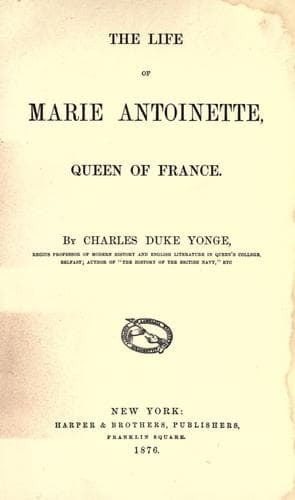
The Life of Marie Antoinette, Queen of FranceYonge, Charles Duke
History
The Life of Marie Antoinette, Queen of France
Yonge, Charles Duke
Marie Antoinette, Queen, consort of Louis XVI, King of France, 1755-1793
In England, the two Houses of Parliament, by a vigilant and systematic
perseverance, had gradually extorted from the sovereign a great and
progressive enlargement of their original powers, till they had almost
engrossed the entire legislative authority in the kingdom. But in France,
a variety of circumstances had prevented the States-general from arriving
at a similar development. And, consequently, as in human affairs very
little is stationary, their authority had steadily diminished, instead of
increasing, till they had become so powerless and utterly insignificant
that, since the year 1615, they had never once been convened. Not only had
they been wholly disused, but they seemed to have been wholly forgotten.
During the last two reigns no one had ever mentioned their name; much less
had any wish been expressed for their resuscitation, till the financial
difficulties of the Government, and the general and growing discontent of
the great majority of the nation, with which, since the death of Turgot,
every successive minister had been manifestly incompetent to deal, had, as
we have seen, led some ardent reformers to demand their restoration, as
the one expedient which had not been tried, and which, therefore, had this
in its favor, that it was not condemned by previous failure.
That great reforms were indispensable was admitted in every quarter. There
was no country in Europe where the feudal system had received so little
modification.[13] Every law seemed to have been made, and every custom to
have been established for the exclusive benefit of the nobles. They were
even exempted from many of the taxes, an exemption which was the more
intolerable from the vast number of persons who were included in the list.
Practically it may be said that there were two classes of nobles--the old
historic houses, as they were sometimes called, such as the Grammonts or
Montmorencies, which were not numerous, and many of which had greatly
decayed in wealth and influence; and an inferior class whose nobility was
derived from their possession of office under the crown in any part of the
kingdom. Even tax-gatherers and surveyors, if appointed by royal warrant,
could claim the rank; and new offices were continually being created and
sold which conferred the same title. Those so ennobled were not reckoned
the equals of the higher class. They could not even be received at court
until their patents were four hundred years old, but they had a right to
vote as nobles at elections to any representative body. Those whose
patents were twenty-four years old could be elected as representatives;
and from the moment of their creation they all enjoyed great exemptions;
so that, as the lowest estimate reckoned their numbers at a hundred
thousand, it is a matter for some wonder how the taxes to which they did
not contribute produced any thing worth collecting. It was, of course,
manifest that the exemptions enormously increased the burden to be borne
Public-domain text, read in full here on John Shaqi.
Reviews
Reviews
No reviews yet
Be the first to share your thoughts on this work.
Elsewhere in the archive
Join the Discussion
Join the discussion
Sign in to leave a comment or review.
Sign InorCreate an account