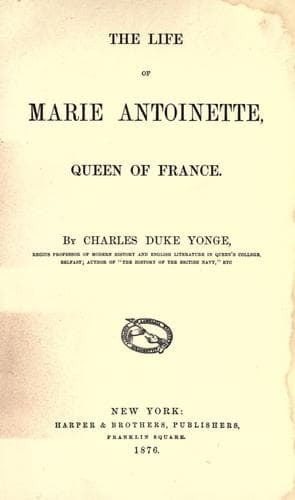
The Life of Marie Antoinette, Queen of FranceYonge, Charles Duke
History
The Life of Marie Antoinette, Queen of France
Yonge, Charles Duke
Marie Antoinette, Queen, consort of Louis XVI, King of France, 1755-1793
by the classes which did not enjoy such privileges.
But, heavy as the grievance of these exemptions was, it was as nothing
when compared with the feudal rights claimed by the greater nobles. The
peasants on their estates were forced to grind their corn at the lord's
mill, to press their grapes at his wine-press, paying for such act
whatever price he might think fit to exact, and often having their crops
wholly wasted or spoiled by the delays which such a system engendered. The
game-laws forbade them to weed their fields lest they should disturb the
young partridges or leverets; to manure the soil with any thing which
might injure their flavor; or even to mow or reap till the grass or corn
was no longer required as shelter for the young coveys. Some of the rights
of seigniory, as it was called, were such as can hardly be mentioned in
this more decorous age; some were so ridiculous that it is inconceivable
how their very absurdity had not led to their abolition. In the marshy
districts of Brittany, one right enjoyed by the great nobles was "the
silence of the frogs,[14]" which, whenever the lady was confined, bound
the peasants to spend their days and nights in beating the swamps with
long poles to save her from being disturbed by their inharmonious
croaking. And if this or any other feudal right was dispensed with, it was
only commuted for a money payment, which was little less burdensome.
The powers exercised by the crown were more intolerable still. The
sovereign was absolute master of the liberties of his subjects. Without
alleging the commission of any crime, he could issue warrants--letters
under seal, as they were called--which consigned the person named in them
to imprisonment, which was often perpetual. The unhappy prisoner had no
power of appeal. No judge could inquire into his case, much less release
him. The arrests were often made with such secrecy and rapidity that his
nearest relations knew not what had become of him, but he was cut off from
the outer world, for the rest of his life, as completely as if he had at
once been handed over to the executioner.[15]
It was impossible but that such customs should produce general discontent,
and a resolute demand for a complete reformation of the system. And one of
the problems which the minister had to determine was, how to organize the
States-general so that they should be disposed to promote such measures as
reform as should be adequate without being excessive; as should give due
protection to the middle and lower classes without depriving the nobles of
that dignity and authority which were not only desirable for themselves,
but useful to their dependents; and, lastly, such as should carefully
preserve the rightful prerogatives of the crown, while putting an end to
those arbitrary powers, the existence of which was incompatible with the
very name of freedom.
Public-domain text, read in full here on John Shaqi.
Reviews
Reviews
No reviews yet
Be the first to share your thoughts on this work.
Elsewhere in the archive
Join the Discussion
Join the discussion
Sign in to leave a comment or review.
Sign InorCreate an account