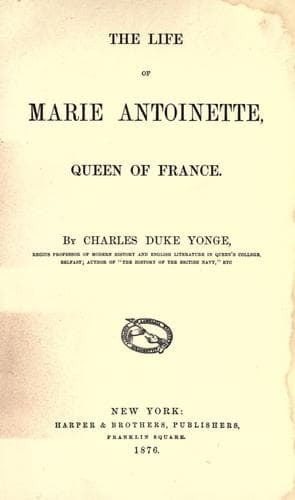
The Life of Marie Antoinette, Queen of FranceYonge, Charles Duke
History
The Life of Marie Antoinette, Queen of France
Yonge, Charles Duke
Marie Antoinette, Queen, consort of Louis XVI, King of France, 1755-1793
Could those who beheld it as spectators, could those who bore a part in
the solemnity, have looked into futurity; could they have divined that no
other hall would ever again see that virtuous and beneficent king
surrounded with that pomp, or received with that reverential homage which
was now paid to him as as unquestioned right; nay, that the end, of which
this day was the beginning, scarcely one single person of all those now
present, whether men in the flower of their strength, women in the pride
of their beauty, or even children in their infantine innocence and grace,
would live to behold; but that sovereigns and subjects were destined,
almost without exception, to perish with circumstances of unutterable,
unimaginable horror and misery, as the direct consequence of this day's
pageant; we may well believe that the most sanguine of those who now
greeted it with eager hope and exultation would rather have averted his
eyes from the ill-omened spectacle, and would have preferred to bear the
worst evils of which he was anticipating the abolition, to bringing on his
country the calamities which were about to fall upon it.
A large state arm-chair, a little lower than the throne, had been set
beside it for the queen; the princes and princesses were ranged on each
side on a row of chairs without arms; and, when all had taken their
places, the king opened the session with a short speech, leaving the real
business to be unfolded at greater length by his ministers. In order to
feel assured of the proper emphasis and expression, he had rehearsed his
speech frequently to the queen; and, as he now delivered it with unusual
dignity and gracefulness, it was received with frequent acclamations,
though some of those who were watching all that passed with the greatest
anxiety fancied that one or two compliments to the queen which it
contained met with a colder response; while, at its close, the
representatives of the Third Estate gave an indication of their feeling
toward the other orders, and provoked a display on their part which
promised little cordiality to their deliberations. The king, who had
uncovered himself while speaking, on resuming his seat replaced his hat.
The Nobles, according to the ancient etiquette, replaced theirs; and many
of the Commons at once asserted their equality with them by also covering
themselves. Such an assumption was a breach of all established custom. The
Nobles were indignant, and with angry shouts demanded the removal of the
Commons' hats. They were met with louder clamor by the Commons, and in a
moment the whole hall was in an uproar, which was only allayed by the
presence of mind of Louis himself, who, as if oppressed by the heat, laid
aside his own hat, when, as a matter of course, the Nobles followed his
example. The deputies of the Commons did the same, and peace was restored.
Public-domain text, read in full here on John Shaqi.
Reviews
Reviews
No reviews yet
Be the first to share your thoughts on this work.
Elsewhere in the archive
Join the Discussion
Join the discussion
Sign in to leave a comment or review.
Sign InorCreate an account