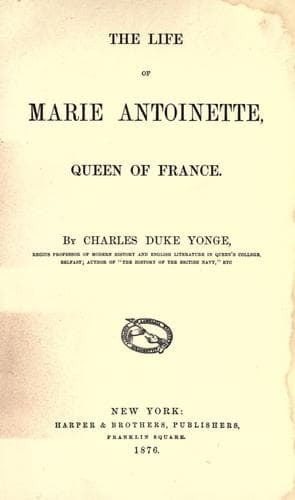
The Life of Marie Antoinette, Queen of FranceYonge, Charles Duke
History
The Life of Marie Antoinette, Queen of France
Yonge, Charles Duke
Marie Antoinette, Queen, consort of Louis XVI, King of France, 1755-1793
When, after some years of misery, the marchioness terminated them by
suicide, he seduced a nun of exquisite beauty to leave her convent for his
sake; and as France was no longer a safe residence for them, he fled to
Frederick of Prussia, who, equally glad to welcome him as a Frenchman, a
genius, and a profligate, received him for a while into high favor. But he
was penniless; and Frederick was never liberal of his money. Debt soon
drove him from Prussia, and he retired to England, where he made
acquaintance with Fox, Fitzpatrick, and other men of mark in the political
circles of the day. He was at all times and amidst all his excesses both
observant and studious; and while witnessing in person the strife of
parties in this country, he learned to appreciate the excellencies of our
Constitution, both in its theory and in its practical working. But
presently debt drove him from London as it had driven him from Berlin;
and, after taking refuge for a short time in Holland and Switzerland, he
was hesitating whither next to betake himself, when, hearing of the
elections for the States-general, he resolved to offer himself as a
candidate; and returned to Provence to seek the suffrages of the Nobles of
his own county.
Unluckily, his character was too well known in his native district; and
the Nobles, unwilling to countenance the ambition of one who had obtained
so evil a notoriety, rejected him. Full of indignation, he turned to the
Third Estate, offering himself as a representative of the Commons. In his
speeches to the citizens of Aix and Marseilles--for he canvassed both
towns--he inveighed against Necker and the Government with an eloquence
which electrified his audience, who had never before been addressed in the
language of independence. He was returned for both towns, and hastened to
Versailles, eager to avenge on the Nobles, the body which, as he felt, he
had a right to have represented, the affront which had driven him, against
his will, to seek the votes of a class with which he had scarcely a
feeling in common; for in the whole Assembly there was no man less of a
democrat in his heart, or prouder of his ancestry and aristocratic
privileges.
Public-domain text, read in full here on John Shaqi.
Reviews
Reviews
No reviews yet
Be the first to share your thoughts on this work.
Elsewhere in the archive
Join the Discussion
Join the discussion
Sign in to leave a comment or review.
Sign InorCreate an account