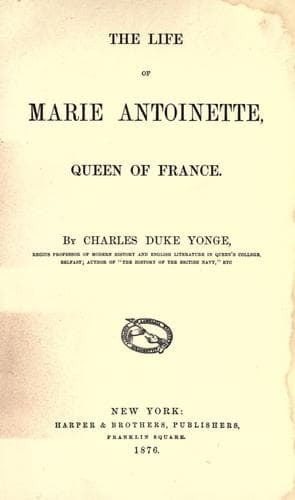
The Life of Marie Antoinette, Queen of FranceYonge, Charles Duke
History
The Life of Marie Antoinette, Queen of France
Yonge, Charles Duke
Marie Antoinette, Queen, consort of Louis XVI, King of France, 1755-1793
He differed from most of his colleagues, inasmuch as he, from the first,
had distinct views of the policy desirable for the nation, which he
conceived to be the establishment of a limited constitutional monarchy,
such as he had seen in England.[8] But no man in the whole Assembly was
more inconsistent, as he was ever changing his views, or at least his
conduct and language, at the dictates of interest or wounded pride;
sometimes, as it might seem, in the mere wantonness of genius, as if he
wished to show that he could lead the Assembly with equal ease to take a
course, or to retrace its steps--that it rested with him alone alike to do
or to undo. The only object from which he never departed was that of
making all parties feel and bow to his influence. And it is this very
inconsistency which so especially connects his career for the rest of his
life with the fortunes of the queen, since, while he misunderstood her
character, and feared her power with the king and ministers as likely to
be exerted in opposition to his own views, he was the most ferocious and
most foul of her enemies: when he saw that she was willing to accept his
aid, and when he therefore began to conceive a hope of making her useful
to himself in the prosecution of his designs, no man was louder in her
praise, nor, it must be admitted, more energetic or more judicious in the
advice which he gave her.
His language on the first occasion on which he made his voice heard in the
Assembly was eminently characteristic of him, so manifestly was it
directed to the attainment of his own object--that of making himself
necessary to the court, and obtaining either office or some pension which
might enable him to live, since his own resources had long been exhausted
by his extravagance. D'Espresménil had strongly advocated the doctrine
that the meeting of the three orders in separate chambers was a
fundamental principle of the monarchy; and Mirabeau, in opposition to him,
moved an address to the king, which represented the Third Estate as
desirous to ally itself with the throne, so as to enable it to resist the
pretensions of the clergy and the nobles; and, as this speech of his
produced no overture from the minister, in the middle of June he made a
direct offer to Necker to support the Government, if Necker had any plan
at all which was in the least reasonable;[9] and he gave proof of his
sincerity by vigorously opposing some proposals of the extreme reformers.
But, with incredible folly, Necker rejected his support, treating his
arguments to his face as insignificant, and affirming that their views
were irreconcilable, since Mirabeau wished to govern by policy, while he
himself preferred morality.
Public-domain text, read in full here on John Shaqi.
Reviews
Reviews
No reviews yet
Be the first to share your thoughts on this work.
Elsewhere in the archive
Join the Discussion
Join the discussion
Sign in to leave a comment or review.
Sign InorCreate an account