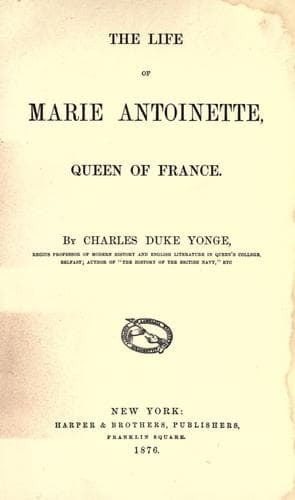
The Life of Marie Antoinette, Queen of FranceYonge, Charles Duke
History
The Life of Marie Antoinette, Queen of France
Yonge, Charles Duke
Marie Antoinette, Queen, consort of Louis XVI, King of France, 1755-1793
Meanwhile, the mob increased every hour. They occupied the court-yard of
the palace, roaring out ferocious threats, the most sanguinary of which
were directed against the queen. The President of the Assembly moved that
the members should adjourn and repair to the palace for the protection of
the royal family, but Mirabeau resisted the proposal, and procured its
rejection; and when a large party of the members went, as individuals, to
place their services at the king's disposal, he mingled with the rioters,
tampering with the soldiers, and urging them to espouse what he called the
cause of the people. As it grew dark, the crowd grew more and more
tumultuous and violent. The Body-guard, who were all gentlemen, were
faithful and fearless; but it began to be seen that none of the other
troops, not even the regiment of Flanders, could be trusted. Some of them
even fired on the Body-guard, and mortally wounded its commander, the
Marquis de Savonières; while Louis, adhering to his unhappy policy of
conciliation even at such a moment, sent down orders to the officer who
succeeded to the command that the men were not to use their weapons, and
that all bloodshed was to be avoided. "Tell the king," replied M.
d'Huillier, "that his orders shall be obeyed; but that we shall all be
assassinated."
The mob grew fiercer when it became known that La Fayette and his regiment
were approaching. No one knew what course he might take, but the
ringleaders of the rioters resolved on a strenuous effort to render his
arrival useless by their previous success. Guns were fired, heavy blows
were dealt on the railings of the inner court-yard and on the gates; and
the danger seemed so imminent that the mob might force its way into the
palace, that the deputies themselves besought the king to delay no longer,
but to retire to Rambouillet. He was still irresolute, and still trusting
to his plan of conciliating by non-resistance. The queen, though more
earnest than ever that he should depart, still nobly adhered to her own
view of duty, and refused to leave him; but, hoping that he might change
his mind, she gave a written order to keep the carriages harnessed, and to
prepare to force a passage for them if the life of the king should appear
to be in danger; but, she added, they were not to be used if she alone
were threatened.
Public-domain text, read in full here on John Shaqi.
Reviews
Reviews
No reviews yet
Be the first to share your thoughts on this work.
Elsewhere in the archive
Join the Discussion
Join the discussion
Sign in to leave a comment or review.
Sign InorCreate an account