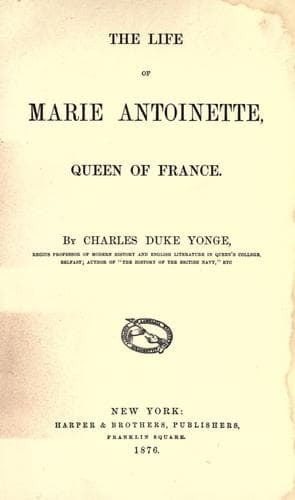
The Life of Marie Antoinette, Queen of FranceYonge, Charles Duke
History
The Life of Marie Antoinette, Queen of France
Yonge, Charles Duke
Marie Antoinette, Queen, consort of Louis XVI, King of France, 1755-1793
At last, when it was nearly midnight, La Fayette arrived. With a singular
perverseness of folly, at a time when every moment was of consequence, he
had halted his men a mile out of the town to make them a speech in praise
of himself and his own loyalty, and to administer to them an oath to be
faithful to the nation, to the law, and to the king; an oath needless if
they were inclined to keep it; useless, if they were not; and in the state
of feeling then common, mischievous in the order in which he ranged the
powers to which he required them to profess allegiance. At last he reached
the palace. Leaving his men below, he ascended to the king's apartments,
and, laying his hand on his heart, assured the king that he had no more
loyal servant than himself. Louis was not given to sarcasm: yet some of
the bystanders fancied that there was a tone of irony in his voice when in
reply he expressed his conviction of the marquis's sincerity; and perhaps
La Fayette thought so too, for he proceeded to harangue his majesty on his
favorite subject of his own courage; describing the dangers which, as he
affirmed, he had incurred in the course of the day. After which he
descended into the court-yard to assure the soldiers that the king had
promised to accede to their wishes; and then returned to the royal
apartments to inform the king that contentment was restored, and that he
himself would be responsible for the tranquillity of the night.
The royal family, exhausted with the fatigues of so terrible a day,
retired to rest, the queen expressly enjoining her ladies to follow her
example. Fortunately they were too anxious for her safety to obey her,
and, with their own attendants, kept watch in the room outside her
bed-chamber. But La Fayette, in spite of the responsibility which he had
taken upon himself, felt no such anxiety. He declared himself tired and
sleepy; and, leaving the palace, went to a friend's house to ask for a
bed.[5] Yet he well knew that the crowd was still assembled around the
palace, and was increasing in violence. Though the night was stormy and
wet, the rioters sought no shelter except such as was afforded by a
hurried resort to the wine-shops in the neighborhood, where they inflamed
their intoxication, and from which they soon returned to renew their
savage clamor and threats, increasing the disorder by keeping up a
frequent fire of their muskets. Throughout the night the Duc d'Orléans was
briskly going to and fro, his emissaries scattering money among the
rioters, who seemed to have no definite purpose or plan, till, as day
began to break, one of the gates leading into the Princes' Court was seen
to be open. It had been intrusted to some of La Fayette's soldiers, and
could not have been opened without treachery. The crowd poured in,
uttering fiercer threats than ever, from the belief that their prey was
within their reach. There was, in truth, nothing between them and the
Public-domain text, read in full here on John Shaqi.
Reviews
Reviews
No reviews yet
Be the first to share your thoughts on this work.
Elsewhere in the archive
Join the Discussion
Join the discussion
Sign in to leave a comment or review.
Sign InorCreate an account