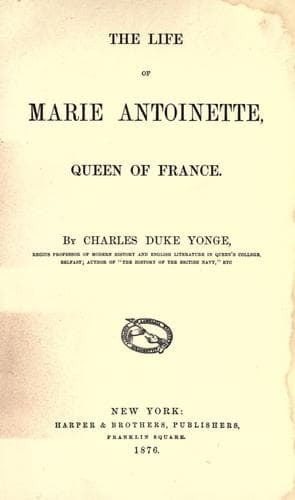
The Life of Marie Antoinette, Queen of FranceYonge, Charles Duke
History
The Life of Marie Antoinette, Queen of France
Yonge, Charles Duke
Marie Antoinette, Queen, consort of Louis XVI, King of France, 1755-1793
The King accepts the Constitution so far as it has been settled.--The
Queen makes a Speech to the Deputies.--She is well received at the
Theatre.--Negotiations with Mirabeau.--The Queen's Views of the Position
of Affairs.--The Jacobin Club denounces Mirabeau.--Deputation of
Anacharsis Clootz.--Demolition of the Statue of Louis XIV.--Abolition of
Titles of Honor.--The Queen admits Mirabeau to an Audience.--His
Admiration of her Courage and Talents.--Anniversary of the Capture of the
Bastile.--Fête of the Champ de Mars.--Presence of Mind of the Queen.
What was probably as painful to Marie Antoinette as these occurrences
themselves was the apathy with which the king regarded them. The English
traveler to whose journal we have more than once referred, and who, in the
first week of the year, saw the royal pair waiting in the gardens of the
Tuileries, remarked that though the queen did not appear in good health,
but showed melancholy and anxiety in her face, the king, on the other
hand, "was as plump as ease could render him.[1]" And in the course of
February, in spite of all her remonstrances, Necker succeeded in
persuading him to go down to the Assembly, and to address the members in a
long speech, in which, though some of his expressions were clearly
intended as a reproof of the Assembly itself for the precipitation and
violence of some of its measures, he nevertheless declared his cordial
assent to the new Constitution, so far as they had yet settled it, and
promised to co-operate in a spirit of affection and confidence in the
labors which still remained to be achieved.
The greater part of the speech is believed to have been his own
composition; and it is characteristic of the fidelity with which, on every
occasion, Marie Antoinette adhered to her rule of strengthening her
husband's position by her own cordial and conspicuous support, that,
strongly as she had objected to the step before it was taken, now that it
was decided on, she professed a decided approval of it; and when a
deputation of the Assembly, which had been appointed to escort the king
with honor back to the palace, solicited an audience of herself to pay
their respects, she assured the deputies that "she partook of all the
sentiments of the king; that she united with all her heart and mind in the
measure which his love for his people had just dictated to him." And then,
bringing the dauphin forward, she added: "Behold my son. I shall
unceasingly speak to him of the virtues of his most excellent father. I
shall teach him from the earliest age to cherish public liberty, and I
hope that he will be its firmest bulwark."
Public-domain text, read in full here on John Shaqi.
Reviews
Reviews
No reviews yet
Be the first to share your thoughts on this work.
Elsewhere in the archive
Join the Discussion
Join the discussion
Sign in to leave a comment or review.
Sign InorCreate an account