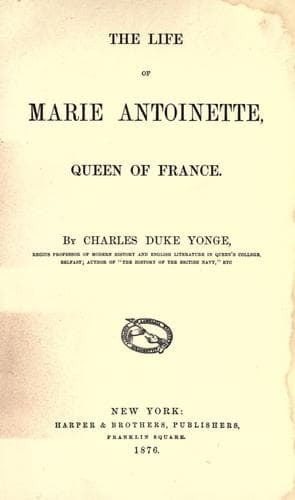
The Life of Marie Antoinette, Queen of FranceYonge, Charles Duke
History
The Life of Marie Antoinette, Queen of France
Yonge, Charles Duke
Marie Antoinette, Queen, consort of Louis XVI, King of France, 1755-1793
For a moment the step seemed to have succeeded, though the proofs of its
success were still more strongly proofs of the utter want of sense that
marked all the proceedings of the Assembly. As Louis had expressed his
assent to the Constitution so far as it was settled, it was proposed, as a
fitting compliment to him, that the Assembly and the whole body of the
citizens of Paris should take an oath of fidelity to the Constitution
without any such reservation. But in the course of the next few weeks the
Assembly showed how little his reproof of its former precipitation and
violence had been heeded, since, among the first measures with which it
proceeded to the completion of the Constitution, one deprived him of the
right of deciding on peace and war, a power which all wise statesmen
regard as inseparable from the executive government; another extinguished
the right of primogeniture; and a third confiscated all the property of
the monastic establishments.
However, those who took the lead in the management of affairs (for Necker
and the ministers had long ceased to exert the slightest authority) were
blinded by their own fury to the absurdity and inconsistency of their
conduct. Their exultation was unbounded, and, adhering to the line of
conduct which she had marked out for herself, Marie Antoinette now yielded
to their entreaties that she would show herself to the citizens at the
theatre. Even in the days of her earliest popularity she had never met a
more enthusiastic reception. The greater part of the house rose at her
entrance, clapping their hands and cheering, and the disloyalty of a few
malcontents only made her triumph more conspicuous, so roughly were they
treated by the rest of the audience. Marie Antoinette was herself touched
at the cordiality with which she was greeted, and saw in it another proof
that "the people and citizens were good at heart if left to themselves;
but," she added to the Princess de Lamballe, to whom she described the
scene, "all this enthusiasm is but a gleam of light, a cry of conscience
which weakness will soon stifle.[2]"
Public-domain text, read in full here on John Shaqi.
Reviews
Reviews
No reviews yet
Be the first to share your thoughts on this work.
Elsewhere in the archive
Join the Discussion
Join the discussion
Sign in to leave a comment or review.
Sign InorCreate an account