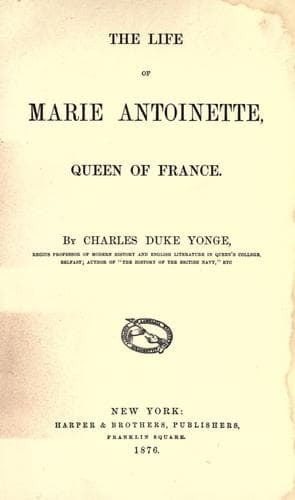
The Life of Marie Antoinette, Queen of FranceYonge, Charles Duke
History
The Life of Marie Antoinette, Queen of France
Yonge, Charles Duke
Marie Antoinette, Queen, consort of Louis XVI, King of France, 1755-1793
As a spectacle few have been more successful, and perhaps none has ever
been so imposing. Before midnight on the 13th of July, the whole of the
vast amphitheatre was filled with a dense crowd, in its gayest holiday
attire--a marvelous and magnificent sight from its mere numbers; and early
the next morning the heads of the procession began to defile under the
arch at the entrance of the plain--La Fayette, at the head of the National
Guard, leading the way. It was a curious proof of the king's weakness, and
of the tenacity with which he clung to his policy of conciliation, that,
in spite of his knowledge of the general's bitter animosity to his
authority and to himself, and of his recent vote for the suppression of
all titles of honor, Louis had offered him the sword of the Constable of
France, a dignity which had been disused for many years; and it was an
equally striking evidence of La Fayette's inveterate disloyalty that,
gratifying as the succession to Duguesclin and Montmorency would have been
to his vanity, he nevertheless refused the honor, and contented himself
with the dignity which the enrollment of the detachments from the
different departments under his banner conferred on him, by giving him the
appearance of being the commander-in-chief of the National Guard
throughout the kingdom. The National Guard was followed by regiment after
regiment, and deputation after deputation, of the regular army; and, to
show the subordination to the law which they were expected to acknowledge
for the future, their swords were all sheathed, while the deputies, the
municipal magistrates, and other peaceful citizens who bore a part in the
procession had their swords drawn. Sailors from the fleet, magistrates and
deputations from every department, and from every city or town of
importance in the kingdom, followed; and after them came two hundred
priests, with Talleyrand, Bishop of Autun, in his episcopal vestments at
their head, their white robes somewhat uncanonically decorated with
tricolor ribbons, who passed on into the centre of the plain and ranged
themselves on the steps of the altar. So vast was the procession that it
was half-past three in the afternoon before the detachment of Royal Guards
which closed it took up their position.
Public-domain text, read in full here on John Shaqi.
Reviews
Reviews
No reviews yet
Be the first to share your thoughts on this work.
Elsewhere in the archive
Join the Discussion
Join the discussion
Sign in to leave a comment or review.
Sign InorCreate an account