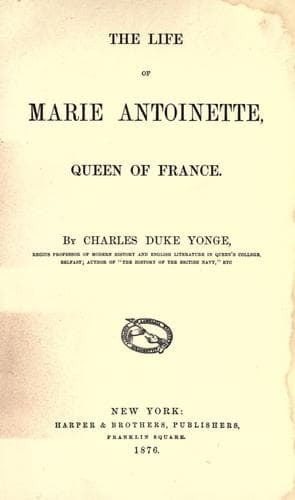
The Life of Marie Antoinette, Queen of FranceYonge, Charles Duke
History
The Life of Marie Antoinette, Queen of France
Yonge, Charles Duke
Marie Antoinette, Queen, consort of Louis XVI, King of France, 1755-1793
When at last all were in their places, Louis, accompanied by the queen and
other members of his family, entered the royal pavilion. He was known by
sight to the deputations from the most distant provinces, for he had
reviewed them in a body the day before, when several of them had been
separately presented to him, toward whom he had for once laid aside his
habitual reserve, assuring them of his fatherly regard for all his
subjects with warmth and manifest sincerity. The queen, too, as she always
did, had made a most favorable impression on those members whom she had
seen by her judicious and cordial affability. Louis wore no robes, but
only the ordinary dress of a French noble. Marie Antoinette was in full
evening costume, and her hair was dressed with a plume of tricolor
feathers. Yet even on this day, which was intended to be one of universal
joy and friendliness, evil signs were not wanting to show how powerful
were the enemies of both king and queen; for no seat whatever had been
provided for her, while by the aide of that constructed for the king
another on very nearly the same level had been placed for the President of
the Assembly.
But these refinements of discourtesy were lost on the spectators. They
cheered the royal pair joyously the moment that they appeared. Before the
shouts had died away, Bishop Talleyrand began the service of the mass;
and, on its termination, administered the oath "of fidelity to the nation,
the law, the king, and the Constitution as decreed by the Assembly and
accepted by the king." La Fayette took the oath first in the name of the
army. Talleyrand followed on behalf of the clergy. Bailly came next, as
the representative of the citizens of Paris. It was a stormy day; and when
the moment arrived for the king to set the seal to the universal
acceptance of the constitution by swearing to exert all his own power for
its maintenance, the rain came down so heavily as to render it impossible
for him to leave the shelter of his own pavilion. As it happened, the
momentary disappointment gave a greater effect to his act. With more than
usual presence of mind, he advanced to the front of the pavilion, so as to
be seen by the whole of the assembled multitude, and took the oath with a
loud voice and perfect dignity of manner. As he resumed his seat, the rain
cleared away, the sun burst through the clouds; and the queen, as if by a
sudden inspiration, brought forward the little dauphin, and, lifting him
up in her arms, showed him to the people. Those whom the king's voice
could not reach saw the graceful action; and from every side of the plain
one universal acclamation burst forth, which seemed to bear out Marie
Antoinette's favorite assertion that the people were good at heart, and
that it was not without great perseverance in artifice and malignity that
they could be excited to disloyalty and treason.
CHAPTER XXVIII.
Public-domain text, read in full here on John Shaqi.
Reviews
Reviews
No reviews yet
Be the first to share your thoughts on this work.
Elsewhere in the archive
Join the Discussion
Join the discussion
Sign in to leave a comment or review.
Sign InorCreate an account