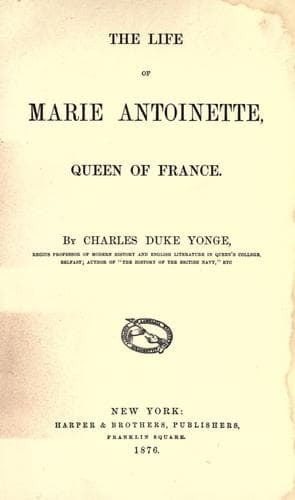
The Life of Marie Antoinette, Queen of FranceYonge, Charles Duke
History
The Life of Marie Antoinette, Queen of France
Yonge, Charles Duke
Marie Antoinette, Queen, consort of Louis XVI, King of France, 1755-1793
For even the Assembly itself was a prey to tumult and violence. From the
time of its assuming that title admission had been given to every one who
could force his way into the chamber, whether he was a member or not; nor
was any order preserved among those who thus obtained admission; but they
were allowed to express their opinion of every speaker and of every speech
by friendly or unfriendly clamor: a practice which, as may well be
supposed, materially influenced many votes. And presently attendance for
that purpose became a trade; some of the most violent deputies hiring a
regularly appointed troop to take their station in the galleries, and
paying them daily wages to applaud or hiss in accordance with the signs
which they themselves made from the body of the hall.[1] And if the
populace was thus the master of the Assembly while at Versailles, this was
far more the case after its removal to Paris, where the number of the idle
portion of the population furnished the Jacobins with far greater means of
intimidating their adversaries.
It was remarkable that La Marck himself, as has been already intimated,
did not fully share the hopes which the king and queen founded on the
adhesion of Mirabeau. It was not only that on one point he had sounder
views than Mirabeau himself--doubting, as he did, whether the mischief
which his vehement friend had formerly done could now be undone by the
same person, merely because he had changed his mind--but he also felt
doubts of Mirabeau's steadiness in his new path, and feared lest eagerness
for popularity, or an innate levity of disposition, might still lead him
astray. As he described him in a letter to Mercy, "he was sometimes very
great and sometimes very little; he could be very useful, and he could be
very mischievous: in a word, he was often above, and sometimes greatly
below, any other man." At another time he speaks of him as "by turns
imprudent through excess of confidence, and lukewarm from distrust;" and
this estimate of the great demagogue, which was not very incorrect, shows,
too, how high an opinion La Marck had formed of the queen's ability and
force of character, for he looks to her "to put a curb on his
inconstancy,[2]" trusting for that result not so much to her power of
fascination as to her clearness of view and resolution.
Public-domain text, read in full here on John Shaqi.
Reviews
Reviews
No reviews yet
Be the first to share your thoughts on this work.
Elsewhere in the archive
Join the Discussion
Join the discussion
Sign in to leave a comment or review.
Sign InorCreate an account