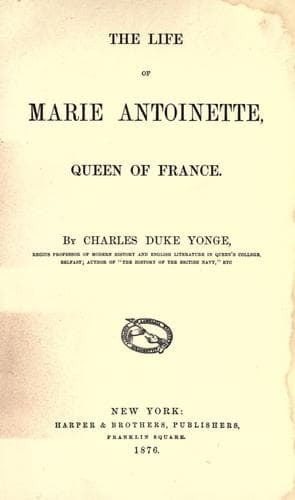
The Life of Marie Antoinette, Queen of FranceYonge, Charles Duke
History
The Life of Marie Antoinette, Queen of France
Yonge, Charles Duke
Marie Antoinette, Queen, consort of Louis XVI, King of France, 1755-1793
And she herself was never so misled by her high estimate of Mirabeau's
abilities and influence as to think his judgment unerring. On the
contrary, her comment to Mercy on one of the earliest letters which he
addressed to the king was that it was "full of madness from one end to the
other," and she asked "how he, or any one else, could expect that at such
a moment the king and she could be induced to provoke a civil war?"
alluding, apparently, to his urgent advice that the royal family should
leave Paris, a step of the necessity for which she was not yet convinced.
Her hope evidently was that he would bring forward some motions in the
Assembly which might at least arrest the progress of mischief, and perhaps
even pave the way for the repair of some of the evil already done.
On one point she partly agreed with him, but not wholly. He insisted on
the necessity of dismissing the ministers; but she, though thinking them,
both as a body and individually, unequal to the crisis, saw great
difficulty in replacing them, since the vote of the preceding winter
forbade the king to select their successors from the members of the
Assembly;[3] and she feared also lest, if he should dismiss them, the
Assembly would carry out a plan which, as it seemed to her, it already
showed great inclination to adopt, of managing every thing by means of
committees, and preventing the appointment of any new administration. Her
view of the situation, and of the king's and her position, varied from
time to time, as indeed their circumstances and the views of the Assembly
appeared to alter. In August she is in great distress, caused by a
decision of the emperor to remove Mercy to the Hague. "I am," she writes
to the embassador, "in despair at your departure, especially at a moment
when affairs are becoming every day more embarrassing and more painful,
and when I have therefore the greater need of an attachment as sincere and
enlightened as yours. But I feel that all the powers, under different
pretexts, will withdraw their ministers one after another. It is
impossible to leave them incessantly exposed to this disorder and license;
but such is my destiny, and I am forced to endure the horror of it to the
very end.[4]" But a fortnight later she tells Madame de Polignac that "for
some days things have been wearing a better complexion. She can not feel
very sanguine, the mischievous folks having such an interest in perverting
every thing, and in hindering every thing which, is reasonable, and such
means of doing so; but at the moment the number of ill-intentioned people
is diminished, or at least the right-thinking of all classes and of all
ranks are more united ... You may depend upon it," she adds, "that
misfortunes have not diminished my resolution or my courage: I shall not
lose any of that; they will only give me more prudence.[5]" Indeed, her
own strength of mind, fortitude, and benevolence were the only things in
Public-domain text, read in full here on John Shaqi.
Reviews
Reviews
No reviews yet
Be the first to share your thoughts on this work.
Elsewhere in the archive
Join the Discussion
Join the discussion
Sign in to leave a comment or review.
Sign InorCreate an account