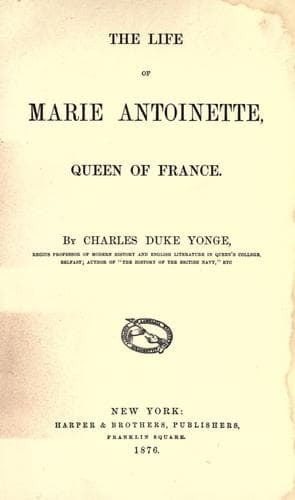
The Life of Marie Antoinette, Queen of FranceYonge, Charles Duke
History
The Life of Marie Antoinette, Queen of France
Yonge, Charles Duke
Marie Antoinette, Queen, consort of Louis XVI, King of France, 1755-1793
"Pardon me, I beg of you," she replied to Leopold, "if I continue to
reject your advice to leave Paris. Consider that I do not belong to
myself. My duty is to remain where Providence has placed me, and to oppose
my body, if the necessity should arise, to the knives of the assassins who
would fain reach the king. I should be unworthy of the name of our mother,
which is as dear to you as to me, if danger could make me desert the king
and my children.[6]"
We have seen that Marie Antoinette dreaded calumny more than the knife or
poison of the assassin; and there could hardly have been a greater proof
how well founded her apprehensions were, and how unscrupulous her enemies,
than is afforded by the fact that, in the latter part of this year, they
actually brought back Madame La Mothe to Paris with the purpose of making
a demand for a re-investigation of the whole story of the fraud on the
jeweler--a pretense for reviving the libelous stories to the disparagement
of the queen, the utter falsehood and absurdity of which had been
demonstrated to the satisfaction of the whole world four years before. Nor
was it wholly a Jacobin plot. La Fayette himself was, to a certain extent,
an accomplice in it. As commander of the National Guard of the city, it
was his duty to apprehend one who was an escaped convict; but instead of
doing so he preferred identifying himself with her, and on one occasion
had what Mirabeau rightly called the inconceivable insolence to threaten
the queen with a divorce on the ground of unfaithfulness to her husband.
She treated his insinuations with the dignity which became herself, and
the scorn which they and their utterers deserved; and he found that his
conduct had created such general disgust among all people who made the
slightest pretense to decency, that he feared to lose his popularity if he
did not disconnect himself from the plotters. Accordingly, he separated
himself from the lady, though he still forbore to arrest her, and for some
time confined himself to his old course of heaping on the royal family
these petty annoyances and insults, which he could inflict with impunity
because they were unobserved except by his victims. It is remarkable,
however, that Mirabeau, who held him in a contempt which, however
deserved, had in it some touch of rivalry and envy, believed that the
queen was not really so much the object of his animosity as the king. In
his eyes "all the manoeuvres of La Fayette were so many attacks on the
queen; and his attacks on the queen were so many steps to bring him within
reach of the king. It was the king whom he really wanted to strike; and he
saw that the individual safety of one of the royal pair was as inseparable
from that of the other as the king was from his crown.[7]" And this
opinion of Mirabeau is strongly corroborated by the Count de la Marck,
who, a few weeks later, had occasion to go to Alsace, and who took great
pains to ascertain the general state of public feeling in the districts
Public-domain text, read in full here on John Shaqi.
Reviews
Reviews
No reviews yet
Be the first to share your thoughts on this work.
Elsewhere in the archive
Join the Discussion
Join the discussion
Sign in to leave a comment or review.
Sign InorCreate an account