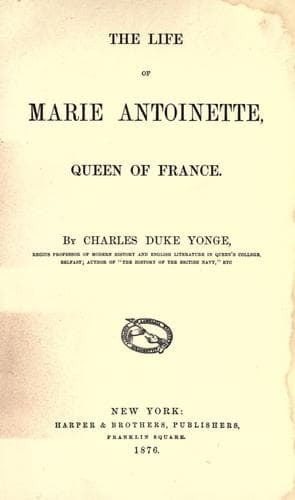
The Life of Marie Antoinette, Queen of FranceYonge, Charles Duke
History
The Life of Marie Antoinette, Queen of France
Yonge, Charles Duke
Marie Antoinette, Queen, consort of Louis XVI, King of France, 1755-1793
through which he passed. During his absence he was in constant
correspondence with those whom he had left behind, and he reports with
great satisfaction that in no part of the country had he found the very
slightest ill-feeling toward the queen. It was in Paris alone that the
different libels against her were forged, and there alone that they found
acceptance; and, manifestly referring to the projected departure from
Paris, he expresses his firm conviction that the moment that she is at
liberty, and able to show herself in the provinces, she will win the
confidence of all classes.[8]
However greatly Mirabeau would, on other grounds, have preferred personal
intercourse with the court, he thought that his power of usefulness
depended so entirely on his connection with it being unsuspected, that he
did not think it prudent to solicit interviews with the queen. But he kept
up a constant communication with the court, sometimes by notes and
elaborate memorials, addressed indeed to Louis, but intended for Marie
Antoinette's perusal and consideration; and sometimes by conversations
with La Marck, which the count was expected to repeat to her. But, in all
the counsels thus given, the thing most to be remarked is the high opinion
which they invariably display of the queen's resolution and ability. Every
thing depends on her; it is from her alone that he wishes to receive
instructions; it is her resolution that must supply the deficiencies of
all around her. When he urges that a line of conduct should be adopted
calculated to render their majesties more popular; that they should show
themselves more in public; that they should walk in the most frequented
places; that they should visit the hospitals, the artisans' workshops, and
make themselves friends by acts of charity and generosity, it is to her
that he looks to carry out his suggestions, and to her affability and
presence of mind that he trusts for the success which is to result from
them;[9] and La Marck is equally convinced that "her ability and
resolution are equal to the conduct of affairs of the first importance."
Meantime her health continued good. It showed her strength of mind that
she never intermitted the recreations which contributed to her strength,
about which she was especially anxious, that she might at all times be
ready to act on any emergency; but rode with Elizabeth with great
regularity in the Bois de Boulogne, even in the depth of the winter; and,
while watching with her habitual vigilance of affection over the education
of her children, she found a pleasant relaxation for herself in providing
them with amusement also; often arranging parties, to which other children
of the same age were invited, and finding amusement herself from watching
their gambols in the long corridor of the Tuileries, their blindman's-buff
and hide-and-seek.[10]
Public-domain text, read in full here on John Shaqi.
Reviews
Reviews
No reviews yet
Be the first to share your thoughts on this work.
Elsewhere in the archive
Join the Discussion
Join the discussion
Sign in to leave a comment or review.
Sign InorCreate an account