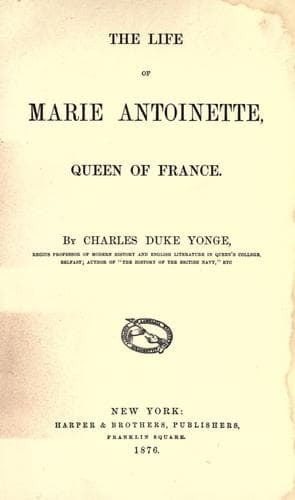
The Life of Marie Antoinette, Queen of FranceYonge, Charles Duke
History
The Life of Marie Antoinette, Queen of France
Yonge, Charles Duke
Marie Antoinette, Queen, consort of Louis XVI, King of France, 1755-1793
But this was too bold a step for Louis to decide on. He anticipated that
the Assembly or the mob might endeavor to prevent such a movement by
force, which could only be repelled by force; and force he was resolved
never to employ. The only alternative was to flee secretly; and in the
course of January, Mercy learns that that plan has been adopted, and that
Compiègne is not considered sufficiently distant from Paris, but that some
fortified place will be selected; Valenciennes being the most likely, as
he himself imagined, since, if farther flight should become necessary, it
would be easy from thence to cross the frontier into the Belgian dominions
of the queen's brother. But if Valenciennes had ever been thought of, it
was rejected on that very account; for Louis had learned from English
history that the withdrawal of James II. from his kingdom had been alleged
as one reason for declaring the throne vacant; and he was resolved not to
give his enemies any plea for passing a similar resolution with respect to
himself. Valenciennes was so celebrated as a frontier town, that the mere
fact of his fixing himself there might easily be represented as an
evidence of his intention to quit the kingdom. But there was a small town
of considerable strength named Montmédy, in the district under the command
of the Marquis de Bouillé, which afforded all the advantages of
Valenciennes, and did not appear equally liable to the same objections.
Montmédy, therefore, was fixed upon; and, in the very first week of
February, Marie Antoinette announced the decision to Mercy; and began her
own preparations by sending him a jewel-case full of those diamonds which
were her private property. She explained to him at considerable length the
reasons which had dictated the choice. The very smallness of Montmédy was
in itself a recommendation, since it would prevent any one from thinking
it likely to be selected as a refuge. It was also so near Luxembourg that,
in the present temper of the nation, which regarded the Austrian power
with "a panic fear," any addition which M. de Bouillé might make to either
the garrison or to his supplies would seem only a wise precaution against
the much-dreaded foreigner. Moreover, the troops in that district were
among the most loyal and well-disposed in the whole army; and if the king
should find it unsafe to remain long at Montmédy, he would have a
trustworthy escort to retreat to Alsace.
Public-domain text, read in full here on John Shaqi.
Reviews
Reviews
No reviews yet
Be the first to share your thoughts on this work.
Elsewhere in the archive
Join the Discussion
Join the discussion
Sign in to leave a comment or review.
Sign InorCreate an account