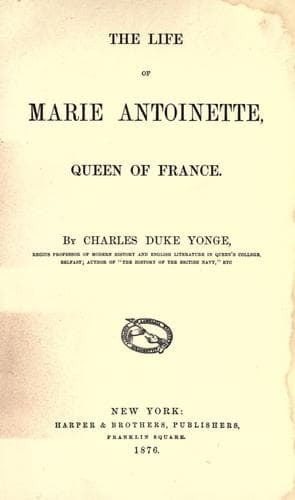
The Life of Marie Antoinette, Queen of FranceYonge, Charles Duke
History
The Life of Marie Antoinette, Queen of France
Yonge, Charles Duke
Marie Antoinette, Queen, consort of Louis XVI, King of France, 1755-1793
She also explained the reasons which had led them to decide on quitting
Paris secretly by night. If they started in the daytime, it would be
necessary to have detachments of troops planted at different spots on
their road to protect them. But M. de Bouillé could not rely on all his
own regiments for such a service, and still less on the National Guards in
the different towns; while to bring up fresh forces from distant quarters
would attract attention, and awaken suspicions beforehand which might be
fatal to the enterprise. Montmédy, therefore, had been decided on, and the
plans were already so far settled that she could tell Mercy that they
should take Madame de Tourzel with them, and travel in one single
carriage, which they had never been seen to use before.
Their preparations had even gone beyond these details, minute as they
were. The king was already collecting materials for a manifesto which he
designed to publish the moment that he found himself safely out of Paris.
It would explain the reasons for his flight; it would declare an amnesty
to the people in general, to whom it would impute no worse fault than that
of being misled (none being excepted but the chief leaders of the disloyal
factions; the city of Paris, unless it should at once return to its
ancient tranquillity; and any persons or bodies who might persist in
remaining in arms). To the nation in general the manifesto would breathe
nothing but affection. The Parliaments would be re-established, but only
as judicial tribunals, which should have no pretense to meddle with the
affairs of administration or finance. In short, the king and she had
determined to take his declaration of the 23d of June[12] as the basis of
the Constitution, with such modifications as subsequent circumstances
might have suggested. Religion would be one of the matters placed in the
foreground.
So sanguine were they, or rather was she, of success, that she had even
taken into consideration the principles on which future ministries should
be constituted; and here for the first time she speaks of herself as
chiefly concerned in planning the future arrangements. "In private we
occupy ourselves with discussing the very difficult choice which we shall
have to make of the persons whom we shall desire to call around us when we
are at liberty. I think that it will be best to place a single man at the
head of affairs, as M. Maurepas was formerly; and if it be settled in this
way, the king would thus escape having to transact business with each
individual minister separately, and affairs would proceed more uniformly
and more steadily. Tell me what you think of this idea. The fit man is not
easy to find, and the more I look for him, the greater inconveniences do I
see in all that occur to me."
Public-domain text, read in full here on John Shaqi.
Reviews
Reviews
No reviews yet
Be the first to share your thoughts on this work.
Elsewhere in the archive
Join the Discussion
Join the discussion
Sign in to leave a comment or review.
Sign InorCreate an account