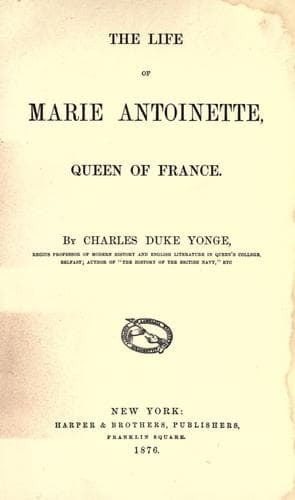
The Life of Marie Antoinette, Queen of FranceYonge, Charles Duke
History
The Life of Marie Antoinette, Queen of France
Yonge, Charles Duke
Marie Antoinette, Queen, consort of Louis XVI, King of France, 1755-1793
diligent reports to the Empress-queen, amounting at times to a diary of
the proceedings of the French court, have a lasting and inestimable value,
since they furnish us with so trustworthy a record of the whole life of
Marie Antoinette for the first ten years of her residence in France,[5] of
her actions, her language, and her very thoughts (for she ever scorned to
give a reason or to make an excuse which was not absolutely and strictly
true), that there is perhaps no person of historical importance whose
conduct in every transaction of gravity or interest is more minutely
known, or whose character there are fuller materials for appreciating.
The very day of her marriage did not pass without her receiving a strange
specimen of the factious spirit which prevailed at the court, and of the
hollowness of the welcome with which the chief nobles had greeted her
arrival. A state ball was given at the palace to celebrate the wedding,
and as the Princess of Lorraine, a cousin of the Emperor Francis, was the
only blood-relation of Marie Antoinette who was at Versailles at the time,
the king assigned her a place in the first quadrille, giving her
precedence for that occasion, next to the princes of the blood. It did not
seem a great stretch of courtesy to show to a foreigner, even had she not
been related to the princess in whose honor the ball was given; but the
dukes and peers fired up at the arrangement, as if an insult had been
offered them. They held a meeting at which they resolved that no member of
their families should attend, and carried out their resolution so
obstinately that at five o'clock, when the dancing was to commence, except
the royal princesses there were only three ladies in the room. The king,
who, following the example of Louis XIV., acted on these occasions as his
own master of ceremonies, was forced to send special and personal orders
to some of those who had absented themselves to attend without delay. And
so by seven o'clock twelve or fourteen couples were collected[6] (the
number of persons admitted to such entertainments was always extremely
small), and the rude disloyalty of the protest was to outward appearance
effaced by the submission of the recusants.
Public-domain text, read in full here on John Shaqi.
Reviews
Reviews
No reviews yet
Be the first to share your thoughts on this work.
Join the Discussion
Join the discussion
Sign in to leave a comment or review.
Sign InorCreate an account