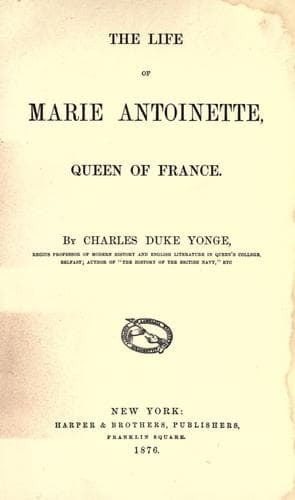
The Life of Marie Antoinette, Queen of FranceYonge, Charles Duke
History
The Life of Marie Antoinette, Queen of France
Yonge, Charles Duke
Marie Antoinette, Queen, consort of Louis XVI, King of France, 1755-1793
Meanwhile, the queen was steadily carrying on the necessary arrangements
for flight. Money had to be provided, for which trustworthy agents were
negotiating in Switzerland and Holland, while some the emperor might be
expected to furnish. Mirabeau marked out for himself what he regarded as a
most important share in the enterprise, undertaking to defend and justify
their departure to the Assembly, and nothing doubting that he should be
able to bring over the majority of the members to his view of that
subject, as he had before prevailed upon them to sanction the journey of
the princesses. But in the first days of April all the hopes of success
which had been founded on his cooperation and support were suddenly
extinguished by his death. Though he had hardly entered upon middle age, a
constant course of excess had made him an old man before his time. In the
latter part of March he was attacked by an illness which his physicians
soon pronounced mortal, and on the 2d of April he died. He had borne the
approach of death with firmness, professing to regret it more for the sake
of his country than for his own. He was leaving behind him no one, as he
affirmed, who would he able to arrest the Revolution as he could have
done; and there can be no doubt that the great bulk of the nation did
place confidence in his power to offer effectual resistance to the designs
of the Jacobins. The various parties in the State showed this feeling
equally by the different manner in which they received the intelligence.
The court and the Royalists openly lamented him. The Jacobins, the
followers of Lameth, and the partisans of the Duke of Orleans, exhibited
the most indecent exultation.[4] But the citizens of Paris mourned for
him, apparently, without reference to party views. They took no heed of
the opposition with which he had of late often defeated the plots of the
leaders whom they had followed to riot and treason. They cast aside all
recollection of the denunciations of him as a friend to the court with
which the streets had lately rung. In their eyes he was the
personification of the Revolution as a whole; to him, as they viewed his
career for the last two years, they owed the independence of the Assembly,
the destruction of the Bastile, and of all other abuses; and through him
they doubted not still to obtain every thing that was necessary for the
completion of their freedom.
Public-domain text, read in full here on John Shaqi.
Reviews
Reviews
No reviews yet
Be the first to share your thoughts on this work.
Elsewhere in the archive
Join the Discussion
Join the discussion
Sign in to leave a comment or review.
Sign InorCreate an account