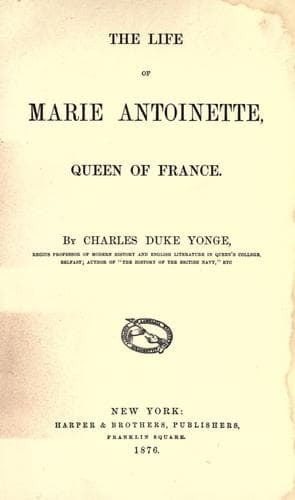
The Life of Marie Antoinette, Queen of FranceYonge, Charles Duke
History
The Life of Marie Antoinette, Queen of France
Yonge, Charles Duke
Marie Antoinette, Queen, consort of Louis XVI, King of France, 1755-1793
His remains were treated with honors never before paid to a subject. He
lay in state; he had a public funeral. His body was laid in the great
Church of St. Geneviève, which, the very day before, had been renamed the
Pantheon, and appropriated as a cemetery for such of her illustrious sons
as France might hereafter think worthy of the national gratitude. Yet,
though his great confidant and panegyrist, M. Dumont,[5] has devoted an
elaborate argument to prove that he had not overestimated his power to
influence the future; and though the Russian embassador, M. Simolin, a
diplomatist of extreme acuteness, seems to imply the same opinion by his
pithy saying that "he ought to have lived two years longer, or died two
years earlier," we can hardly agree with them. La Marck, as has been seen,
even when first opening the negotiation for his connection with the court,
doubted whether he would be able to undo the mischief which he had
acquiesced in, measures not of reform nor of reconstruction, but of total
abolition and destruction, are in their very nature irrevocable and
irremediable. The nobility was gone; he had not resisted its suppression.
The Church was gone; he had himself been among the foremost of its
assailants. How, even if he had wished it, could he have undone these
acts? and if he could not, how, without those indispensable pillars and
supports, could any monarchy endure? That he was now fully alive to the
magnitude of the dangers which encompassed both throne and people, and
that he would have labored vigorously to avert them, we may do him the
justice to believe. But it seems not so probable that he would have
succeeded, as that he would have added one more to the list of these
politicians who, having allowed their own selfish aims to carry them
beyond the limits of prudence and justice, have afterward found it
impossible to retrace their steps, but have learned to their shame and
sorrow that their rashness has but led to the disappointment of their
hopes, the permanent downfall of their own reputations, and the ruin of
what they would gladly have defended and preserved. And, on the whole, it
is well that from time to time such lessons should be impressed upon the
world. It is well that men of lofty genius and pure patriotism should
learn, equally with the most shallow empiric or the most self-seeking
demagogue, that false steps in politics can rarely be retraced; that
concessions once made can seldom, if ever, be recalled, but are usually
the stepping-stones to others still more extensive; that what it would
have been easy to preserve, it is commonly impossible to repair or to
restore.
Public-domain text, read in full here on John Shaqi.
Reviews
Reviews
No reviews yet
Be the first to share your thoughts on this work.
Elsewhere in the archive
Join the Discussion
Join the discussion
Sign in to leave a comment or review.
Sign InorCreate an account