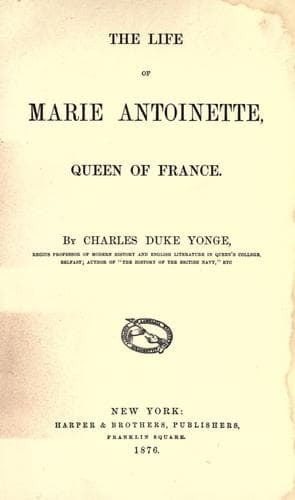
The Life of Marie Antoinette, Queen of FranceYonge, Charles Duke
History
The Life of Marie Antoinette, Queen of France
Yonge, Charles Duke
Marie Antoinette, Queen, consort of Louis XVI, King of France, 1755-1793
When was there ever a journey so miserable as that which now brought its
sovereigns back to that disloyal and hostile city! The National Guard of
Varennes, and of other towns through which they passed, claimed a right to
accompany them; and as they were all infantry, the speed of the carriage
was limited to their walking pace. So slowly did the procession advance,
that it was not till the fourth day that it reached the barrier; and, in
many places on the road, a mob had collected in expectation of their
arrival, and aggravated the misery of their situation by ferocious threats
addressed to the queen, and even to the little dauphin. But at Châlons
they were received with respect by the municipal authorities; the Hôtel de
Ville had been prepared for their reception: a supper had been provided.
The queen was even entreated to allow some of the principal ladies of the
city to be presented to her; and, as the next day was the great Roman
Catholic festival of the Fête Dieu, they were escorted with all honor to
hear mass in the cathedral, before they resumed their journey. Even the
National Guard were not all hostile or insolent. At Épernay, though a
menacing crowd surrounded the carriage as they dismounted, the commanding
officer took up the dauphin in his arms to carry him in safety to the door
of the hotel; comforting the queen at the same time with a loyal whisper
well suited to her feelings, "Despise this clamor, madame; there is a God
above all."
But, miserable as their journey was, soon after leaving Châlons it became
more wretched still. They were no longer to be allowed the privilege of
suffering and grieving by themselves. The Assembly had sent three of its
members to take charge of them, selecting, as might have been expected,
two who were known as among their bitterest enemies--Barnave, and a man
named Pétion; the third, M. Latour Maubourg, was a plain soldier, who
might be depended on for carrying out his orders with resolution. In one
respect those who made the choice were disappointed. Barnave, whose
hostility to the king and queen had been chiefly dictated by personal
feelings, was entirely converted by the dignified resignation of the
queen, and from this day renounced his republicanism; and, though he
adhered to what were known as Constitutionalist views, was ever afterward
a zealous advocate of both the monarch and the monarchy. But Pétion took
every opportunity of insulting Louis, haranguing him on the future
abolition of royalty, and reproaching him for many of his actions, and for
what he believed to be his feelings and views for the future.
Public-domain text, read in full here on John Shaqi.
Reviews
Reviews
No reviews yet
Be the first to share your thoughts on this work.
Elsewhere in the archive
Join the Discussion
Join the discussion
Sign in to leave a comment or review.
Sign InorCreate an account