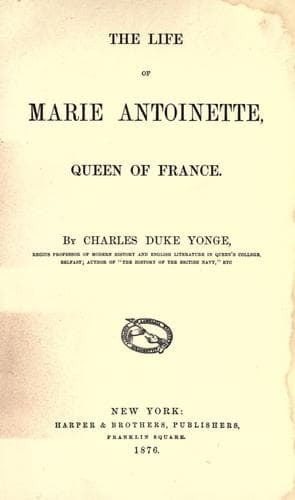
The Life of Marie Antoinette, Queen of FranceYonge, Charles Duke
History
The Life of Marie Antoinette, Queen of France
Yonge, Charles Duke
Marie Antoinette, Queen, consort of Louis XVI, King of France, 1755-1793
It was the afternoon of the 25th when they came in sight of Paris. So
great had been Marie Antoinette's mental sufferings that in those few days
her hair had turned white; and fresh and studied humiliations were yet in
store for her. The carriage was not allowed to take the shortest road, but
was conducted some miles round, that it might be led in triumph down the
Champs Élysées, where a vast mob was waiting to feast their eyes on the
spectacle, whose display of sullen ill-will had been bespoken by a notice
prohibiting any one from taking off his hat to the king, or uttering a
cheer. The National Guard were forbidden to present arms to him; and it
seemed as if they interpreted this order as a prohibition also against
using them in his defense; for, as the carriage approached the palace, a
gang of desperate ruffians, some of whom were recognized as among the most
ferocious of the former assailants of Versailles, forced their way through
their ranks, pressed up against the carriage, and even mounted on the
steps. Barnave and Latour Maubourg, fearing that they intended to break
open the doors, placed themselves against them; but they contented
themselves with looking in at the window, and uttering sanguinary threats.
Marie Antoinette became alarmed--not for herself, but for her children.
They had so closed up every avenue of air that those within were nearly
stifled, and the youngest, of course, suffered most. She let down a glass,
and appealed to those who were crowding round: "For the love of God," she
exclaimed, "retire; my children are choking!" "We will soon choke you,"
was the only reply they vouchsafed to her. At last, however, La Fayette
came up with an armed escort, and they were driven off; but they still
followed the carriage up to the very gate of the palace with yells of
insult. And it had a stranger follower still: behind the royal carriage
came an open cabriolet, in which sat Drouet, with a laurel crown on his
head,[3] as if the chief object of the procession wore to celebrate his
triumph over his king.
The mob was even hoping to add to its impressiveness by the slaughter of
some immediate victims--not of the king and queen, for they believed them
to be destined to public execution; but they were eager to massacre the
faithful Body-guards, who had been brought back, bound, on the box of the
carriage; and they would undoubtedly have carried out their bloody purpose
had not the queen remembered them, and, as she was dismounting, entreated
Barnave and La Fayette to protect them. Though during the last three days
many things had had their names altered,[4] the Tuileries had been spared.
It was still in name a royal palace, but those who now entered it knew it
for their prison. The sun was setting, the emblem of the extinction of
their royalty, as they ascended the stairs to find such rest as they
might, and to ponder in privacy for this one night over their fatal
disappointment, and their still more fatal future.
Public-domain text, read in full here on John Shaqi.
Reviews
Reviews
No reviews yet
Be the first to share your thoughts on this work.
Elsewhere in the archive
Join the Discussion
Join the discussion
Sign in to leave a comment or review.
Sign InorCreate an account