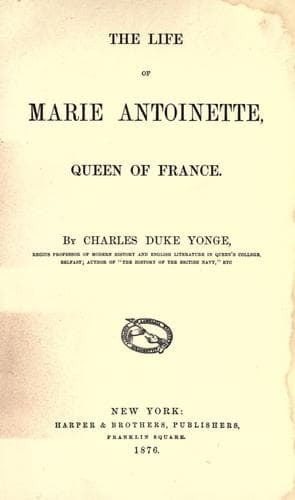
The Life of Marie Antoinette, Queen of France — John Shaqi
The Life of Marie Antoinette, Queen of FranceYonge, Charles Duke
History
The Life of Marie Antoinette, Queen of France
Yonge, Charles Duke
Marie Antoinette, Queen, consort of Louis XVI, King of France, 1755-1793
The dauphin and dauphiness were deeply shocked by a disaster so painfully
at variance with their own happiness, which, in one sense, had caused it.
Their first thought was, as far as they might be able, to mitigate it.
Most of the victims were of the poorer class, the grief of whose surviving
relatives was, in many instances, aggravated by the loss of the means of
livelihood which the labors of those who had been cut off had hitherto
supplied; and, to give temporary succor to this distress, the dauphin and
dauphiness at once drew out from the royal treasury the sums allowed to
them for their private expenses for the month, and sent the money to the
municipal authorities to be applied to the relief of the sufferers. But
Marie Antoinette did more. She felt that to give money only was but cold
benevolence; and she made personal visits to many of those families which
had been most grievously afflicted, showing the sincerity of her sympathy
by the touching kindness of her language, and by the tears which she
mingled with those of the widow and the orphan.[7] Such unmerited kindness
made a deep impression on the citizens. Since the time of Henry IV. no
prince had ever shown the slightest interest in the happiness or misery of
the lower classes; and the feeling of affectionate gratitude which this
unprecedented recognition of their claims to be sympathized with as
fellow-creatures awakened was fixed still more deeply in their hearts a
short time afterward, when, at one of the hunting-parties which took place
at Fontainebleau, the stag charged a crowd of the spectators and severely
wounded a peasant with his horns. Marie Antoinette sprung to the ground at
the sight, helped to bind up the wound, and had the man driven in her own
carriage to his cabin, whither she followed him herself to see that every
proper attention was paid to him.[8] And the affection which she thus
inspired among the poor was fully shared by the chief personage in the
kingdom, the sovereign himself. A life of profligacy had not rendered
Louis wholly insensible to the superior attractions of innocence and
virtue. Perhaps a secret sense of shame at the slavery in which his vices
held him, and which, as he well knew, excited the contempt of even his
most dissolute courtiers, though he had not sufficient energy to shake it
off, may have for a moment quickened his better feelings; and the fresh
beauty of the young princess, who, from the first moment of her arrival at
the court, treated him with the most affectionate and caressing respect,
awakened in him a genuine admiration and good-will. He praised her beauty
and her grace to all his nobles with a warmth that excited the jealousy of
his infamous mistress, the Countess du Barri. He made allowance for some
childishness of manner as natural at her age,[9] showed an anxiety for
every thing which could amuse or gratify her, which afforded a marked
contrast to his ordinary apathy. And, though in so young a girl it was
Public-domain text, read in full here on John Shaqi.
Reviews
Reviews
No reviews yet
Be the first to share your thoughts on this work.
Join the Discussion
Join the discussion
Sign in to leave a comment or review.
Sign InorCreate an account