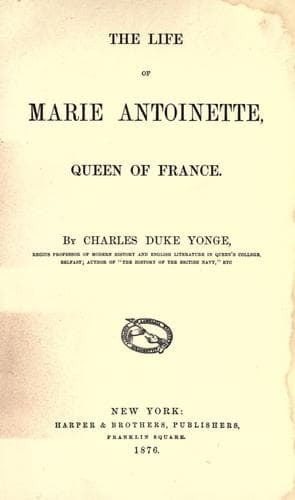
The Life of Marie Antoinette, Queen of FranceYonge, Charles Duke
History
The Life of Marie Antoinette, Queen of France
Yonge, Charles Duke
Marie Antoinette, Queen, consort of Louis XVI, King of France, 1755-1793
Yet, though their return was full of ignominy and wretchedness, though
their home had become a prison, the only exit from which was to be the
scaffold, still, if posthumous renown can compensate for miseries endured
in this life; if it be worth while to purchase, even by the most terrible
and protracted sufferings, an undying, unfading memory of the most
admirable virtues--of fidelity, of truth, of patience, of resignation, of
disinterestedness, of fortitude, of all the qualities which most ennoble
and sanctify the heart--it may be said, now that her agonies have long
been terminated, and that she has been long at rest, that it was well for
Marie Antoinette that she had failed to reach Montmédy, and that she had
thus fallen again, without having to reproach herself in any single
particular, into the hands of her enemies. As a prisoner to the basest of
mankind, as victim to the most ferocious monsters that have ever disgraced
humanity, she has ever commanded, and she will never cease to command, the
sympathy and admiration of every generous mind. But the case would have
been widely different had Louis and she found the refuge which they sought
with the loyal and brave De Bouillé. Their arrival in his camp could not
have failed to be a signal for civil war; and civil war, under such
circumstances as those of France at that time, could have had but one
termination--their defeat, dethronement, and expulsion from the country.
In a foreign land they might, indeed, have found security, but they would
have enjoyed but little happiness. Wherever he may be, the life of a
deposed and exiled sovereign must be one of ceaseless mortification. The
greatest of the Italian poets has well said that the recollection of
former happiness is the bitterest aggravation of present misery; and not
only to the fugitive monarch himself, but to those who still preserve
their fidelity to him, and to the foreign people to whom he is indebted
for his asylum, the recollection of his former greatness will ever be at
hand to add still further bitterness to his present humiliation. The most
friendly feeling his misfortunes can ever excite is a contemptuous pity,
such as noble and proud minds must find it harder to endure than the
utmost virulence of hatred and enmity.
From such a fate, at least, Marie Antoinette was saved. During the
remainder of her life her failure did indeed condemn her to a protraction
of trial and agony such as no other woman has ever endured; but she always
prized honor far above life, and it also opened to her an immortality of
glory such as no other woman has ever achieved.
CHAPTER XXXII.
Public-domain text, read in full here on John Shaqi.
Reviews
Reviews
No reviews yet
Be the first to share your thoughts on this work.
Elsewhere in the archive
Join the Discussion
Join the discussion
Sign in to leave a comment or review.
Sign InorCreate an account