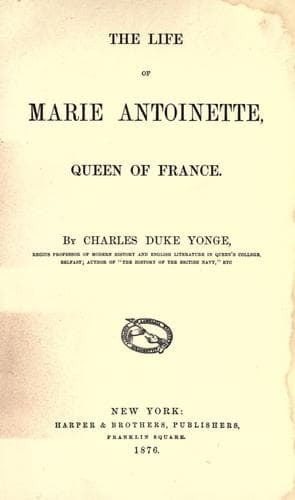
The Life of Marie Antoinette, Queen of FranceYonge, Charles Duke
History
The Life of Marie Antoinette, Queen of France
Yonge, Charles Duke
Marie Antoinette, Queen, consort of Louis XVI, King of France, 1755-1793
The decision of the Assembly also on the question, of the king's conduct
in leaving Paris was not without its encouragement to one of the queen's
disposition. She herself had been interrogated by commissioners appointed
by the Assembly to inquire into the circumstances connected with the
transaction, and her statement has been preserved. With her habitual
anxiety to conceal from others the king's incapacity and want of
resolution, she represented herself as acting wholly under his orders. "I
declare," said she, "that as the king desired to quit Paris with his
children, it would have been unnatural for me to allow any thing to
prevent me from accompanying him. During the last two years, I have
sufficiently proved, on several occasions, that I should never leave him;
and what in this instance determined me most was the assurance which I
felt that he would never wish to quit the kingdom. If he had had such a
desire, all my influence would have been exerted to dissuade him from such
a purpose[3]." And she proceeded further to exculpate all their
attendants. She declared that Madame de Tourzel, who had been ill for some
weeks, had never received her orders till the very day of the departure.
She knew not whither she was going, and had taken no luggage, so that the
queen herself had been forced to lend her some clothes. The three
Body-guards were equally ignorant, and the waiting-women. Though it was
true, she said, that the Count and Countess de Provence had gone to
Flanders, they had only taken that course to avoid interfering with the
relays which were required by the king, and had intended to rejoin him at
Montmédy. The king's own statement tallied with hers in every respect,
though it was naturally more explicit as to his motives and intentions;
and his innocence of purpose was so irresistibly demonstrated, that,
though Robespierre, in the most sanguinary speech which, he had ever yet
uttered, demanded that he should be brought to trial, not concealing his
desire that it should end in his condemnation; and though Pétion, and a
wretch named Buzot, a warm admirer and intimate friend of Madame Roland,
demanded his deposition and the proclamation of a republic, Barnave had no
difficulty in carrying the Assembly with him in opposition to their
violence; and it was finally resolved that nothing which had happened
furnished grounds for taking proceedings against any member of the royal
family. It was ordered at the same time that De Bouillé should be arrested
and impeached; but when he found that nothing could be effected for the
deliverance of the king, he had fled across the frontiers, and was safe
from their malice.
Public-domain text, read in full here on John Shaqi.
Reviews
Reviews
No reviews yet
Be the first to share your thoughts on this work.
Elsewhere in the archive
Join the Discussion
Join the discussion
Sign in to leave a comment or review.
Sign InorCreate an account