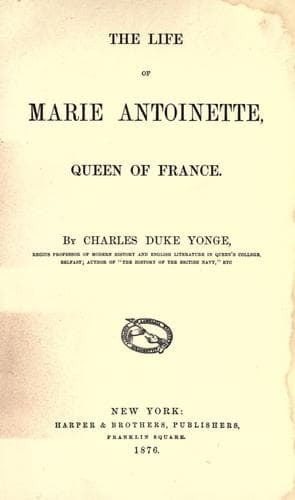
The Life of Marie Antoinette, Queen of FranceYonge, Charles Duke
History
The Life of Marie Antoinette, Queen of France
Yonge, Charles Duke
Marie Antoinette, Queen, consort of Louis XVI, King of France, 1755-1793
Meanwhile, the unconstitutional and unprecedented violence which had been
offered to the king naturally created the greatest excitement and
indignation in all foreign countries. A month before the late expedition,
the emperor had addressed a formal note to M. Montmorin, as Secretary of
State, declaring that he would regard any ill-treatment of his sister as
an injury done to himself;[4] and now[5] the chivalrous Gustavus of Sweden
proposed to address to the Assembly a joint letter of warning from all the
sovereigns of Europe, to declare that they would all make common cause
with the King of France if any attempt were made to offer him further
violence. But even the Austrian ministers regarded such a declaration as
more likely to aggravate than to diminish the dangers of those whom it was
designed to serve; and the queen herself preferred waiting for a time, to
see the result of the strife between the rival parties in the Assembly.
The Assembly was at this time fully occupied with the completion of the
Constitution, a work for which it had but little time left, since its own
duration had been fixed at two years, which would expire in September; and
also with the consideration of a question concerning the composition of
the next Assembly which had been lately brought forward, and on which the
queen was unfortunately misled into using her influence to procure a
decision which was undoubtedly, in its eventual consequences, as
disastrous to the king's fortunes as it was irreconcilable with common
sense. Robespierre brought forward a resolution that no members of the
existing Assembly should be eligible for a seat in that by which it was to
be replaced. It was in reality a resolution to exclude from the new
Assembly not only every one who had any parliamentary or legislative
experience, but also all the adherents or friends of the throne, and to
place the coming elections wholly in the power of the Jacobins.
Robespierre was willing to be excluded himself from a conviction, that,
with such an Assembly as would surely be returned, the Jacobin Club would
practically exercise all the power of the State. But the Constitutional
party, who saw that it was aimed at them, opposed it with great vigor; and
would probably have been able to defeat it if the Royalist members who
still retained their seats would have consented to join them. Unhappily
the queen took the opposite view. With far more acuteness, penetration,
and fertility of imagination than are usually given to women, or to men
either, she had still in some degree the defect common to her sex, of
being prone to confine her views to one side of a question; and to
overrule her reason by her feelings and prejudices. Though she
acknowledged the service which Barnave had rendered by defeating those who
had wished to bring the king and herself to trial, she, nevertheless,
still regarded the Constitutionalists in general with deep distrust as the
Public-domain text, read in full here on John Shaqi.
Reviews
Reviews
No reviews yet
Be the first to share your thoughts on this work.
Elsewhere in the archive
Join the Discussion
Join the discussion
Sign in to leave a comment or review.
Sign InorCreate an account