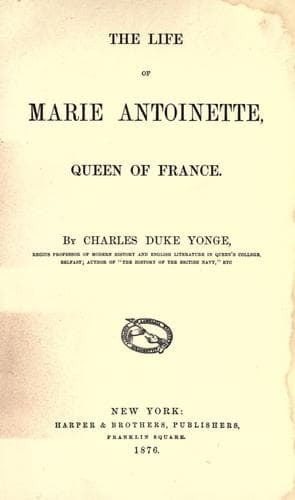
The Life of Marie Antoinette, Queen of FranceYonge, Charles Duke
History
The Life of Marie Antoinette, Queen of France
Yonge, Charles Duke
Marie Antoinette, Queen, consort of Louis XVI, King of France, 1755-1793
The very rejoicings were turned by the agents of the Jacobins into
occasions for further outrages. The whole city was illuminated, and the
sovereigns yielded to the entreaties of the popular leaders, to drive
through the streets and the Champs Élysées to see the illumination. The
populace, who believed the Revolution at an end and their freedom secured,
cheered them heartily as they passed; but at every cry of "Vive le roi," a
stentorian voice, close to the royal carriage, shouted out, "Not so: Vive
la nation!" and the queen, though it was plain that the ruffian had been
hired thus to outrage them, almost fainted with terror at his ferocity. A
few days afterward, the insults were renewed even more pointedly. The
royal family went in state to the opera, where, before their arrival, the
Jacobins had packed the pit with a gang of their own hirelings, whose
unpowdered hair made them conspicuous objects.[18] The opera was one of
Grétry's, "Les Événements Imprévus," in which one of the duets contains
the line "Ah, comme j'aime ma maïtresse." Madame Dugazon, a popular singer
of the day, as she uttered the words, bowed toward the royal box, and
instantly the whole pit was in a fury. "No mistress for us! no master!
Liberty!" The whole house was in an uproar. The king's partisans and
adherents replied with loyal cheers, "Vive le roi! Vive la reine!" The pit
roared out, "No master! no queen!" and the Jacobins even proceeded to acts
of violence toward all who refused to join in their cry. Blows were
struck, and it became necessary to send for a company of the Guard to
restore order.
Yet when, on the last day of the month, the king visited the Assembly[19]
to declare its dissolution, the president addressed him in terms of the
most loyal gratitude, affirming that by his acceptance of the
Constitution, he had earned the blessings of all future generations; and
when he quitted the hall, the populace escorted the royal carriage back to
the palace with vociferous cheers. Though, in the eyes of impartial
observers, this display of returning good-will was more than
counterbalanced when, as the members of the Assembly came out, some of the
Royalists and Constitutionalists were hooted, and some of the fiercest
Jacobins were greeted with still more enthusiastic acclamations.
CHAPTER XXXIII.
Composition of the New Assembly.--Rise of the Girondins,--Their Corruption
and Eventual Fate.--Vergniaud's Motions against the King.--Favorable
Reception of the King at the Assembly, and at the Opera.--Changes in the
Ministry.--The King's and Queen's Language to M. Bertrand de Moleville.--
The Count de Narbonne.--Pétion is elected Mayor of Paris.--Scarcity of
Money, and Great Hardships of the Royal Family.--Presents arrive from
Tippoo Sahib.--The Dauphin.--The Assembly passes Decrees against the
Priests and the Emigrants.--Misconduct of the Emigrants.--Louis refuses
his Assent to the Decrees.--He issues a Circular condemning Emigration.
Public-domain text, read in full here on John Shaqi.
Reviews
Reviews
No reviews yet
Be the first to share your thoughts on this work.
Elsewhere in the archive
Join the Discussion
Join the discussion
Sign in to leave a comment or review.
Sign InorCreate an account