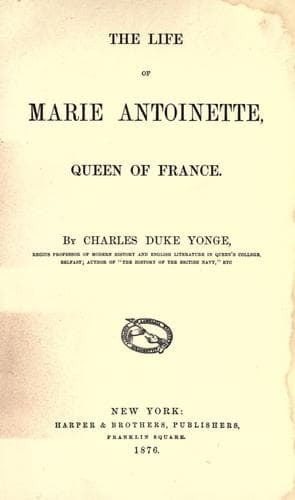
The Life of Marie Antoinette, Queen of FranceYonge, Charles Duke
History
The Life of Marie Antoinette, Queen of France
Yonge, Charles Duke
Marie Antoinette, Queen, consort of Louis XVI, King of France, 1755-1793
Nor was M. Bertrand the only one of the ministers who received proofs of
the resolution of the queen to adhere steadily to the Constitution. There
was also a new minister of war, the Count de Narbonne, as firmly attached
to the persons of the sovereigns as M. Bertrand himself, though in
political principle more inclined to the views of the Constitutionalists
than to those of the extreme Royalists. He was likewise a man of
considerable capacity, eloquent and fertile in resources; but he was
ambitious and somewhat vain; and he was so elated at the approval
expressed by the Assembly of a report on the military resources of the
kingdom which he laid before it soon after his appointment, that he
obtained an audience of the queen, the object of which was to convince her
that the only means of saving the State was to confer on a man of talent,
energy, sagacity, and activity, who enjoyed the confidence of the Assembly
and of the nation, the post of prime minister; and he admitted that he
intended to designate himself by this description. Marie Antoinette,
though fully aware of the desirableness of having a single man of ability
and firmness at the head of the administration, was for a moment surprised
out of her habitual courtesy. She could not forbear a smile, and in plain
terms asked him "if he were crazy.[4]" But she proceeded with her usual
kindness to explain to him the impracticability of the scheme which he had
suggested, and the foundation of her argument was an explanation that such
an appointment would be a violation of the Constitution, which forbade the
king to create any new ministerial office. And the count deserves to have
it mentioned to his honor that the rebuff which he had received in no
degree cooled his attachment to the king and queen, or the zeal with which
he labored for their service.
We have no information how far the new minister coincided in a step which
the queen took in the course of November, and which is commonly ascribed
to her judgment alone. Before its dissolution, the late Assembly had
broken up the National Guard of Paris into separate legions, and had
suppressed the appointment of commander-in-chief of the forces; and La
Fayette, whom this measure had left without employment, feeling keenly the
diminution of his importance, and instigated by the restlessness common to
men of moderate capacity, conceived the hope of succeeding Bailly in the
mayoralty of Paris, which that magistrate was on the point of resigning.
Public-domain text, read in full here on John Shaqi.
Reviews
Reviews
No reviews yet
Be the first to share your thoughts on this work.
Elsewhere in the archive
Join the Discussion
Join the discussion
Sign in to leave a comment or review.
Sign InorCreate an account