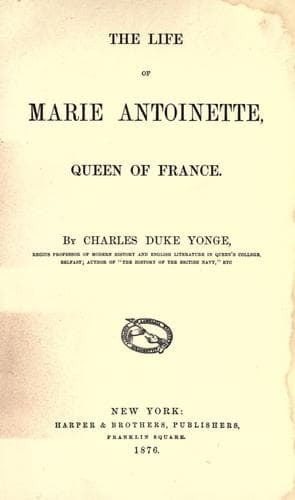
The Life of Marie Antoinette, Queen of FranceYonge, Charles Duke
History
The Life of Marie Antoinette, Queen of France
Yonge, Charles Duke
Marie Antoinette, Queen, consort of Louis XVI, King of France, 1755-1793
It had become a post of great consequence, since the extent to which the
authority of the crown had been pared away tended to make the mayor the
absolute dictator of the capital; and consequently the Jacobins were
anxious to secure the office for one of the extreme Revolutionary party,
and set up Pétion as a rival candidate. The election belonged to the
citizens, and, as in the city the two parties possessed almost equal
strength, it was soon seen that the court, which had by no means lost its
influence among the tradesmen and shop-keepers, had the power of deciding
the contest in favor of the candidate for whom it should pronounce, Marie
Antoinette declared for Pétion. She knew him to be a Jacobin,[5] but he
was so devoid of any reputation for ability that she did not fear him.
Nor, except that he had behaved with boorish disrespect and ill-manners
during their melancholy return from Varennes, had she any reason for
suspecting him of any special enmity to the king.
But La Fayette, though always loud in his professions of loyalty, had
never lost an opportunity of offering personal insults to both the king
and herself. It was to his shameful neglect (to put his conduct in the
most favorable light) that she justly attributed the danger to which she
had been exposed at Versailles, and the compulsion which had been put upon
the king to take up his residence in Paris; and, not to mention a constant
series of petty insults which he had heaped on both Louis and herself, and
on the Royalists as a body, he had given unmistakable proofs of his
personal animosity toward the king by his conduct on the 21st of June, and
by the indecent rigor with which he treated them both after their return
from Varennes. Even when he was loudest in the profession of his desire
and power to influence the Assembly in the king's favor, one of his own
friends had told him to his face that he was insincere,[6] and that Louis
could not and ought not to trust his promises; and every part of his
conduct toward the royal pair was stamped with duplicity as well as with
ill-will. It was not strange, therefore, indeed it was fully consistent
with the honest openness of Marie Antoinette's own character, that she
should prefer an open enemy to a pretended friend. She even believed what,
from the very commencement of the Revolution, many had suspected, that La
Fayette cherished views of personal ambition, and aimed at reviving the
old authority of a Maire du Palais over a Roi Fainéant[7]. She therefore
directed her friends to throw their weight into the scale in favor of
Pétion, who was accordingly elected by a great majority, while the
marquis, greatly chagrined, retired for a time to his estate in Auvergne.
Public-domain text, read in full here on John Shaqi.
Reviews
Reviews
No reviews yet
Be the first to share your thoughts on this work.
Elsewhere in the archive
Join the Discussion
Join the discussion
Sign in to leave a comment or review.
Sign InorCreate an account