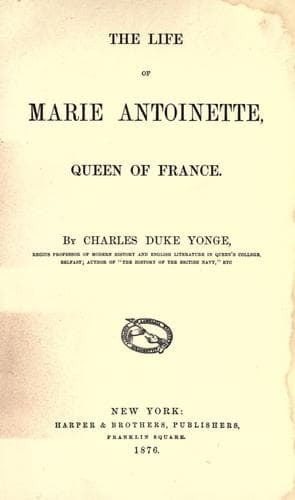
The Life of Marie Antoinette, Queen of FranceYonge, Charles Duke
History
The Life of Marie Antoinette, Queen of France
Yonge, Charles Duke
Marie Antoinette, Queen, consort of Louis XVI, King of France, 1755-1793
The royal couple still kept their health, the king's apathy being in this
respect as beneficial as the queen's courage: they still rode a great deal
when the weather was favorable; and on one occasion, at the beginning of
1792, the queen, with her sister-in-law and her daughter, went again to
the theatre. The opera was the same which had been performed at the visit
in October; but this time the Jacobins had not been forewarned so as to
pack the house, and Madame du Gazon's duet was received with enthusiasm.
Again, as she sung "Ah, que j'aime ma maîtresse!" she bowed to the royal
box, and the audience cheered. As if in reply to one verse, "Il faut les
rendre heureux," "Oui, oui!" with lively unanimity, came from all parts of
the house, and the singers were compelled to repeat the duet four times.
"It is a queer nation this of ours," says the Princess Elizabeth, in
relating the scene to one of her correspondents, "but we must allow that
it has very charming moments.[9]"
A somewhat curious episode to divert their minds from these domestic
anxieties was presented by an embassy from the brave and intriguing Sultan
of Mysore, the celebrated Tippoo Sahib, who sought to engage Louis to lend
him six thousand French troops, with whose aid he trusted to break down
the ascendency which England was rapidly establishing in India. Tippoo
backed his request, in the Oriental fashion, by presents, though not such
as, in the opinion of M. Bertrand, were quite worthy of the giver or of
the receiver. To the king he sent some diamonds, but they were yellow,
ill-cut, and ill-set; and the rest of the offering was composed of a few
pieces of embroidered silk, striped cloth, and cambric: while the queen's
present consisted of nothing more valuable than a few bottles of perfume
of no very exquisite quality, and a few boxes of powdered scents, pastils,
and matches. The king and queen gave nearly the whole present to M.
Bertrand for his grandchildren, the queen only reserving a bottle of attar
of rose and a couple of pieces of cambric; and that chiefly to afford a
pretext for seeing M. Bertrand once or twice, without his reception being
imputed to a desire to promote some Austrian intrigue; for the Jacobins
had lately revived the clamor against Austrian influence with greater
vehemence than ever.
Public-domain text, read in full here on John Shaqi.
Reviews
Reviews
No reviews yet
Be the first to share your thoughts on this work.
Elsewhere in the archive
Join the Discussion
Join the discussion
Sign in to leave a comment or review.
Sign InorCreate an account