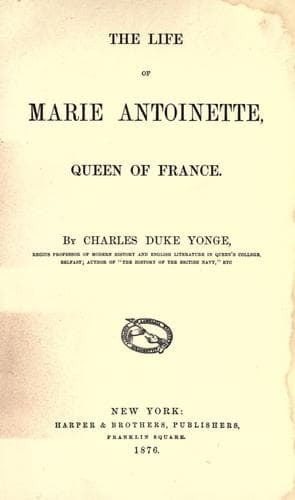
The Life of Marie Antoinette, Queen of FranceYonge, Charles Duke
History
The Life of Marie Antoinette, Queen of France
Yonge, Charles Duke
Marie Antoinette, Queen, consort of Louis XVI, King of France, 1755-1793
The victory, however, was an unfortunate one for the court. It contributed
to increase the confidence of its enemies; and, as their instinct showed
them that it was from the resolution of the queen that they had the most
formidable opposition to dread, it was against her that, from their first
entrance into the Assembly, Vergniaud and his friends specially exerted
themselves; Vergniaud openly contending that the inviolability of the
sovereign, which was an article of the new Constitution, applied only to
the king himself, and in no degree to his consort; while in the Jacobin
and Cordelier Clubs the coarsest libels were poured forth against her with
unremitting perseverance to stimulate and justify the most obscene and
ferocious threats. The coarsest ruffians in a street quarrel never used
fouler language of one another than these men of education applied to the
pure-minded and magnanimous lady whose sole offense was that she was the
wife of their kind-hearted king.
And, in addition to this daily increase of their danger which such
denunciations could not fail to augment, the royal family were now
suffering inconveniences which even those whose measures had caused them
had never designed. They were in the most painful want of money. The
agitation of the last two years had rendered the treasury bankrupt. The
paper money, which now composed almost the whole circulation of the
country, was valueless. While, as it was in this paper money (assignats,
as the notes were called, as being professedly secured by assignments on
the royal domains and on the ecclesiastical property which had been
confiscated), that the king's civil list was paid, at the latter end of
each month it was not uncommon for him and the queen to be absolutely
destitute. It was with great reluctance that they accepted loans from
their loyal adherents, because they saw no prospect of being able to repay
them; but had they not availed themselves of this resource, they would at
times have wanted absolute necessaries.[8]
Public-domain text, read in full here on John Shaqi.
Reviews
Reviews
No reviews yet
Be the first to share your thoughts on this work.
Elsewhere in the archive
Join the Discussion
Join the discussion
Sign in to leave a comment or review.
Sign InorCreate an account