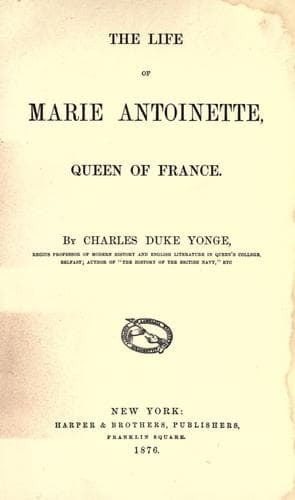
The Life of Marie Antoinette, Queen of FranceYonge, Charles Duke
History
The Life of Marie Antoinette, Queen of France
Yonge, Charles Duke
Marie Antoinette, Queen, consort of Louis XVI, King of France, 1755-1793
Both Jacobins and Girondins felt that the departure of Dumouriez from
Paris had removed a formidable obstacle from their path, and they at once
began to hurry forward the preparations for their meditated insurrection.
The general gave in his resignation on the 15th of June, and the 20th was
fixed for an attack on the palace, by which its contrivers designed to
effect the overthrow of the throne, if not the destruction of the entire
royal family. It was organized with unusual deliberation. The meetings of
conspirators were attended not only by the Girondin leaders, to whom
Madame Roland had recently added a new recruit, a young barrister from the
South, named Barbaroux, remarkable for his personal beauty, and, as was
soon seen, for a pitiless hardness of heart, and energetic delight in
deeds of cruelty that, even in that blood-thirsty company, was equaled by
few; with them met all those as yet most notorious for ferocity--Danton
and Legendre, the founders of the Cordeliers; Marat, daily, in his obscene
and blasphemous newspaper, clamoring for wholesale bloodshed; Santerre,
odious as the sanguinary leader of the very first outbreaks of the
Revolution; Rotondo, already, as we have seen, detected in attempting to
assassinate the queen; and Pétion, who thus repaid her preference of him
to La Fayette, which had placed him in the mayoralty, whose duties he was
now betraying. Some, too, bore a part in the foul conspiracy as partisans
of the Duc d'Orléans, who were generally understood to have instructions
to be lavish of their master's gold, the vile prince hoping that the
result of the outbreak would be the assassination of his cousin, and his
own elevation to the vacant throne. In their speeches they gave Louis the
name of Monsieur Veto, in allusion to the still legal exercise of his
prerogative, by which he had sought to protect the priests; while the
queen was called Madame Veto, though in fact she had finally joined
Dumouriez in urging her husband to give his royal assent to the decree
against them, not, as thinking it on any pretense justifiable, but as
believing, with the general, in the impossibility of maintaining its
rejection. Yet nothing could more completely prove the absolute innocence
and unimpeachable good faith of both king and queen than the act of his
enemies in giving them this nickname; so clear an evidence was it that
they could allege nothing more odious against them than the possession by
Louis, in a most modified degree, of a prerogative which, without any
modification at all, has in every country been at all times regarded as
indispensable to, and inseparable from, royalty; and the exercise of it
for the defense of a body of men of whom none could deny the entire
harmlessness.
Public-domain text, read in full here on John Shaqi.
Reviews
Reviews
No reviews yet
Be the first to share your thoughts on this work.
Elsewhere in the archive
Join the Discussion
Join the discussion
Sign in to leave a comment or review.
Sign InorCreate an account