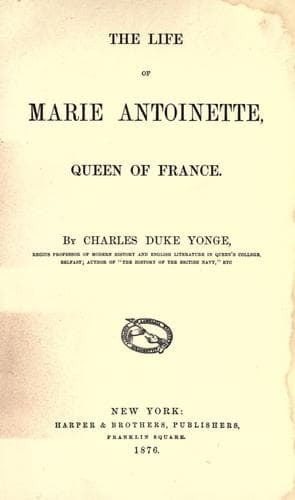
The Life of Marie Antoinette, Queen of FranceYonge, Charles Duke
History
The Life of Marie Antoinette, Queen of France
Yonge, Charles Duke
Marie Antoinette, Queen, consort of Louis XVI, King of France, 1755-1793
On the night of the 19th the appointed leaders of the different bands into
which the insurgents were to be divided separated; the watch-word,
"Destruction to the palace," was given out; and all Paris waited in
anxious terror for the events of the morrow. Louis was as well aware as
any of the citizens of the intended attack, and prepared for it as for
death. On the afternoon of the 19th he wrote to his confessor to desire
him to come to him at once. "He had never," he said, "had such need of his
consolations. He had done with this world, and his thoughts were now fixed
on Heaven alone. Great calamities were announced for the morrow; but he
felt that he had courage to meet them." And after the holy man had left
him, as he gazed on the setting sun he once more gave utterance to his
forebodings. "Who can tell," said he, "whether it be not the last that I
shall ever see?" The Royalists felt his danger almost as keenly as
himself, but were powerless to prevent it by any means of their own. The
Duke de Liancourt, who had some title to be listened to by the
Revolutionary party, since no one had been more zealous in promoting the
most violent measures of the first Assembly, pressed earnestly on Pétion
that his duty as mayor bound him to call out the National Guards, and so
prevent the intended outbreak, but was answered by sarcasms and insults;
while Vergniaud, from the tribune of the Assembly itself, dared to deride
all who apprehended danger.
On the morning of the 20th, daylight had scarcely dawned when twenty
thousand men, the greater part of whom were armed with some weapon or
other--muskets, pikes, hatchets, crowbars, and even spits from the
cook-shops forming part of their equipment--assembled on the place where
the Bastile had stood. Santerre was already there on horseback as their
appointed leader; and, when all were collected and marshaled in three
divisions, they began their march. One division had for its chief the
Marquis de St. Huruge, an intimate friend and adherent of the Duc
d'Orléans; at the head of another, a woman of notorious infamy, known as
La Belle Liégeoise, clad in male attire, rode astride upon a cannon;
while, as it advanced, the crowd was every moment swelled by vast bodies
of recruits, among whom were numbers of women, whose imprecations in
ferocity and foulness surpassed even the foulest threats of the men.
Public-domain text, read in full here on John Shaqi.
Reviews
Reviews
No reviews yet
Be the first to share your thoughts on this work.
Elsewhere in the archive
Join the Discussion
Join the discussion
Sign in to leave a comment or review.
Sign InorCreate an account