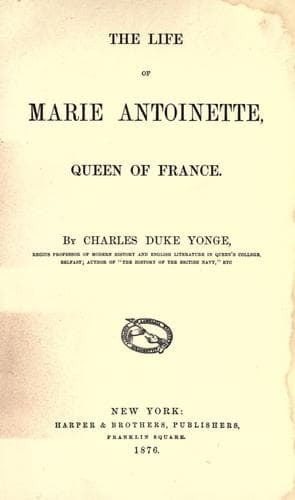
The Life of Marie Antoinette, Queen of FranceYonge, Charles Duke
History
The Life of Marie Antoinette, Queen of France
Yonge, Charles Duke
Marie Antoinette, Queen, consort of Louis XVI, King of France, 1755-1793
The ostensible object of the procession was to present petitions to the
king and the Assembly on the dismissal of Roland and his colleagues from
the administration, and on the refusal of the royal assent to the decree
against the priests. The real design of those who had organized it was
more truthfully shown by the banners and emblems borne aloft in the ranks.
"Beware the Lamp,[1]" was the inscription on one. "Death to Veto and his
wife," was read upon another. A gang of butchers carried a calf's heart on
the point of a pike, with "The Heart of an Aristocrat" for a motto. A band
of crossing-sweepers, or of men who professed to be such, though the
fineness of their linen was inconsistent with the rags which were their
outward garments, had for their standard a pair of ragged breeches, with
the inscription, "Tremble, tyrants; here are the Sans-culottes." One gang
of ruffians carried a model of a guillotine. Another bore aloft a
miniature gallows with an effigy of the queen herself hanging from it. So
great was the crowd that it was nearly three in the afternoon before the
head of it reached the Assembly, where its approach had raised a debate on
the propriety of receiving any petition at all which was to be presented
in so menacing a guise; M. Roederer, the procurator-syndic, or chief legal
officer of the department of Paris, recommending its rejection, on the
ground that such a procession was illegal, not only because of its avowed
object of forcing its way to the king, but also because it was likely to
lead into acts of violence even if it had not premeditated them.
His arguments were earnestly supported by the constitutionalists, and
opposed and ridiculed by Vergniaud. But before the discussion was over,
the rioters, who had now reached the hall, took the decision into their
own hands, forced open the door, and put forward a spokesman to read what
they called a petition, but which was in truth a sanguinary denunciation
of those whom it proclaimed the enemies of the nation, and of whom it
demanded that "the land should be purged." Insolent and ferocious as it
was, it, however, coincided with the feelings of the Girondins, who were
now the masters of the Assembly. One orator carried a motion that the
petitioners should receive what were called the honors of the Assembly;
or, in other words, should be allowed to enter the hall with their arms
and defile before them. They poured in with exulting uproar. Songs, half
blood-thirsty and half obscene, gestures indicative some of murder, some
of debauchery, cries of "Vive la nation!" interspersed with inarticulate
yells, were the sounds, the guillotine and the queen upon the gallows were
the sights, which were thought in character with the legislature of a
people which still claimed to be regarded as the pattern of civilization
by all Europe. Evening approached before the last of the rabble had passed
through the hall; and by that time the leading ranks were in front of the
Tuileries.
Public-domain text, read in full here on John Shaqi.
Reviews
Reviews
No reviews yet
Be the first to share your thoughts on this work.
Elsewhere in the archive
Join the Discussion
Join the discussion
Sign in to leave a comment or review.
Sign InorCreate an account