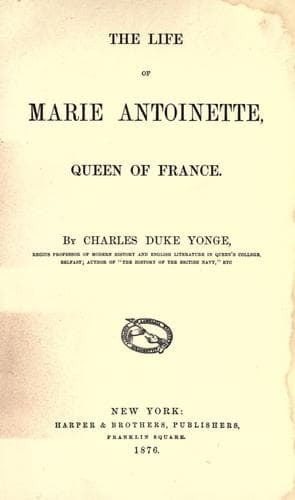
The Life of Marie Antoinette, Queen of FranceYonge, Charles Duke
History
The Life of Marie Antoinette, Queen of France
Yonge, Charles Duke
Marie Antoinette, Queen, consort of Louis XVI, King of France, 1755-1793
There can be no doubt that, though she often pushed her strictness too
far, Madame de Noailles to some extent had reason on her side; and that a
certain degree of ceremony and stately reserve is indispensable in court
life. It is a penalty which those born in the purple must pay for their
dignity, that they can have no friend on a perfect equality with
themselves; and those who in different ages and countries have tried to
emancipate themselves from this law of their rank have not generally won
even the respect of those to whom they have condescended, and still less
the approbation of the outer world, whose members have perhaps a secret
dislike to see those whom they regard as their own equals lifted above
them by the familiarity of princes.
This, however, was a matter of comparatively slight importance. An excess
of condescension is at the worst a venial and an amiable error; but even
at the early period plots were being contrived against the young princess,
which, if successful, would have been wholly destructive of her happiness,
and which, though she was fully aware of them, she had not means by
herself to disconcert or defeat. They were the more formidable because
they were partly political, embracing a scheme for the removal of a
minister, and consequently conciliated more supporters and insured greater
perseverance than if they had merely aimed at securing a preponderance of
court favor for the plotters. Like all the other mistresses who had
successfully reigned in the French courts, Madame du Barri had a party of
adherents who hoped to rise by her patronage. The Duc de Choiseul himself
had owed his promotion to her predecessor, Madame de Pompadour, and those
who hoped to supplant him saw in a similar influence the best prospect of
attaining their end. One of the least respectable of the French nobles was
the Duc d'Aiguillon. As Governor of Brittany, he had behaved with
notorious cowardice in the Seven Years' War. He had since been, if
possible, still more dishonored by charges of oppression, peculation, and
subornation, on which the authorities of the province had prosecuted him,
and which the Parisian Parliament had pronounced to be established. But no
kind of infamy was a barrier to the favor of Louis XV. He cancelled the
resolution of the Parliament, and showed such countenance to the culprit
that d'Aiguillon, who was both ambitious and covetous, conceived the idea
of supplanting Choiseul in the Government. As one of Choiseul's principal
measures had been the negotiation of the dauphin's marriage, Marie
Antoinette was known to regard him with a good-will which was founded on
gratitude. But, unfortunately, her feelings on this point were not shared
by her husband; for Choiseul had had notorious differences with his
father, the late dauphin, and, though it was perfectly certain that that
prince had died of natural disease, people had been found to whisper in
his son's ear suspicions that he had been poisoned, and that the minister
Public-domain text, read in full here on John Shaqi.
Reviews
Reviews
No reviews yet
Be the first to share your thoughts on this work.
Join the Discussion
Join the discussion
Sign in to leave a comment or review.
Sign InorCreate an account