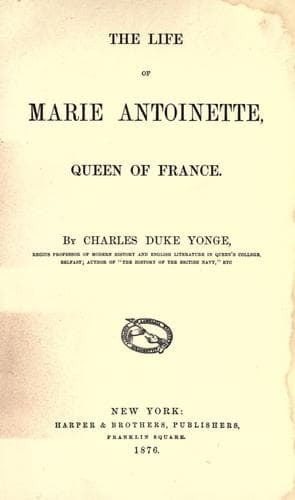
The Life of Marie Antoinette, Queen of FranceYonge, Charles Duke
History
The Life of Marie Antoinette, Queen of France
Yonge, Charles Duke
Marie Antoinette, Queen, consort of Louis XVI, King of France, 1755-1793
It was the peculiar ill-fortune of Louis that more than once the very
efforts made by people who desired to assist him increased his perils. The
events of the 20th of June had shocked and alarmed even La Fayette. From
the beginning of the Revolution he had vacillated between a desire for a
republic and for a limited monarchy on something like the English pattern,
without being able to decide which to prefer. He had shown himself willing
to court a base popularity with the mob by heaping uncalled-for insults on
the king and queen. But though he had coquetted with the ultra-
revolutionists, and allowed them to make a tool of him, he had not nerve
for the villainies which it was now clear that they meditated. He had no
taste for bloodshed; and, though gifted with but little acuteness, he saw
that the success of the Jacobins and Girondins would lead neither to a
republic nor to a limited monarchy, but to anarchy; and he had discernment
enough to dread that. He therefore now sincerely desired to save the
king's life, and even what remained of his authority, especially if he
could so order matters that their preservation should be seen to be his
own work. He was conscious also that he could reckon on many allies in any
effort which he might make for the prevention of further outrages. The
more respectable portion of the Parisians viewed the recent outrages with
disgust, sharpened by personal alarm. The dominion of Santerre and his
gangs of destitute desperadoes was manifestly fraught with destruction to
themselves as well as to the king. The greater part of the army under his
command shared these feelings, and would gladly have followed him to Paris
to crush the revolutionary clubs, and to inflict condign punishment on the
authors and chief agents in the late insurrection. If he had but had the
skill to avail himself of this favorable state of feeling, there can be
little doubt that it was in his power at this moment to have established
the king in the full exercise of all the authority vested in him by the
Constitution, or even to have induced the Assembly to enlarge that
authority. He so mismanaged matters that he only increased the king's
danger, and brought general contempt and imminent danger on himself
likewise. His enemies had more than once accused him of wishing to copy
Cromwell. His friends had boasted that he would emulate Monk. But if he
was too scrupulous for the audacious wickedness of the one, he proved
himself equally devoid of the well-calculating shrewdness of the other.
If, subsequently, he had any reason to congratulate himself on the result
of his conduct, it was that, like the stork in the fable, after be had
thrust his head into the mouth of the wolf, he was allowed to draw it out
again in safety.
Public-domain text, read in full here on John Shaqi.
Reviews
Reviews
No reviews yet
Be the first to share your thoughts on this work.
Elsewhere in the archive
Join the Discussion
Join the discussion
Sign in to leave a comment or review.
Sign InorCreate an account