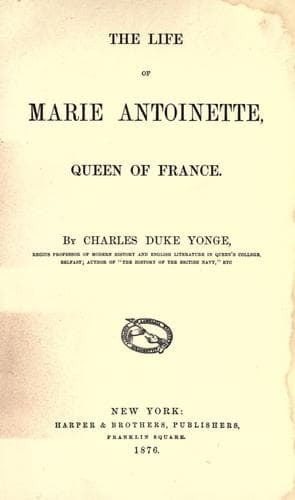
The Life of Marie Antoinette, Queen of FranceYonge, Charles Duke
History
The Life of Marie Antoinette, Queen of France
Yonge, Charles Duke
Marie Antoinette, Queen, consort of Louis XVI, King of France, 1755-1793
Louis's enemies had abundantly shown that they did not lack boldness. If
they were to be defeated, it could only be by action as bold as their own.
Unhappily, La Fayette's courage had usually found vent rather in
blustering words than in stout deeds; and those were the only weapons he
could bring himself to employ now. He resolved to remonstrate with the
Assembly; but instead of bringing up his army, or even a detachment, to
back his remonstrance, he came to Paris with a single aid-de-camp, and, on
the 28th of June, presented himself at the bar of the Assembly and
demanded an audience. A fortnight before he had written a letter to the
president, in which he had denounced alike the Jacobin leaders of the
clubs and the Girondin ministers, and had called on the Assembly to
suppress the clubs; a letter which had produced no effect except to unite
the two parties against whom it was aimed more closely together, and also
to give them a warning of his hostility to them, which, till he was in a
position to show it by deeds, it would have been wiser to have avoided.
He now repeated by word of mouth the statements and arguments which he had
previously advanced in writing, with the addition of a denunciation of the
recent insurrection and its authors, whom, he insisted, the Assembly was
bound instantly to prosecute. His speech was not ill received; for the
Constitutionalists, who knew what he designed to say, had mustered in full
force, and had packed the galleries beforehand with hired clappers; and
many even of the Deputies who did not belong to that party cheered him, so
obvious to all but the most desperate was the danger to the whole State,
if Santerre and his brigands should be allowed to become its masters. But
they cared little for a barren indignation which had no more effectual
weapon than reproaches. He had said enough to exasperate, but had not done
enough to intimidate; while those whom he denounced had greater boldness
and presence of mind than he, and had the forces on which they relied for
support at hand and available. They instantly turned the latter on
himself, and in their turn denounced him for having left his army without
leave. He was frightened, or at least perplexed, by such a charge. He made
no reply, but seemed like one stupefied; and it was only through the
eloquence of one of his friends, M. Ramond, that he was saved from the
impeachment with which Guadet and Vergniaud openly threatened him for
quitting the army without leave.
Public-domain text, read in full here on John Shaqi.
Reviews
Reviews
No reviews yet
Be the first to share your thoughts on this work.
Elsewhere in the archive
Join the Discussion
Join the discussion
Sign in to leave a comment or review.
Sign InorCreate an account