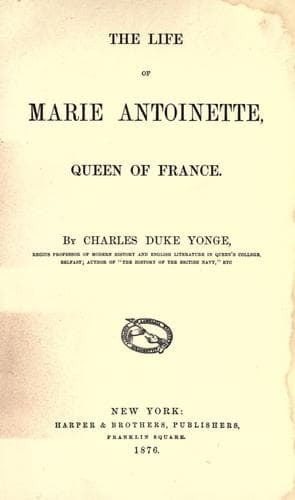
The Life of Marie Antoinette, Queen of FranceYonge, Charles Duke
History
The Life of Marie Antoinette, Queen of France
Yonge, Charles Duke
Marie Antoinette, Queen, consort of Louis XVI, King of France, 1755-1793
Louis XIV. had taught his nobles the pernicious notion that an order to
withdraw from the court was a penal banishment, and his successor now
banished Madame de Grammont fourteen leagues from Versailles, and for some
time refused to recall his sentence, though Marie Antoinette herself wrote
to him to complain of one of her servants being so treated for such a
cause. She had not, as she reported to her mother, been very willing to
write, knowing that Madame du Barri read all the king's letters; but Mercy
had urged her to take the step, thinking it very important that she should
establish the practice of communicating directly with Louis on all matters
relating to her own household, and that she should avoid the blunder of
his daughters, her aunts, whose conduct toward their father had, in his
opinion, been mischievously timid, and to follow whose example would be
prejudicial both to her dignity and to her comfort.
The aunts too, and especially the eldest, Madame Adelaide, had schemes of
their own, which, they also sought to carry out by underhand methods. The
more conscious they were that they themselves had no influence over their
father, the less could they endure the chance of their niece acquiring
any, though it could not have been said to have been established at their
expense. On the other hand, they had before his marriage had considerable
power with the dauphin, which they had now but little hope of retaining.
They saw also that Marie Antoinette had in a few weeks gained a general
popularity such as they had never won in their whole lives, and on all
these accounts they were painfully jealous of her. They put ideas and
plans into her head which they expected to grate upon their father's taste
or indolence, and then contrived to have them represented or
misrepresented to him, though he disappointed their malice by regarding
such things as childish ebullitions natural to a girl of her age, and was
far more inclined to humor than to reprove her. With the same object, they
tried to induce her to interfere in appointments in which she had no
concern; but she remembered her mother's advice, and on this point kept
steadily in the path which that affectionate adviser had marked out for
her. They even ventured to make disparaging observations on her manners,
as inexperienced and unformed, to the dauphin himself, till he silenced
them by the warmth of his praises alike of her beauty and of her
disposition; and they were so afraid of any addition to her popularity
with the nation at large, that, when the city of Paris and the states of
Languedoc presented her with an address, they recommended her to make no
reply, assuring her that on similar occasions they themselves had never
given any answers. Luckily, she had a better adviser, who on this occasion
was the Abbé de Vermond. He told her truly that in this matter the conduct
which the older princesses had pursued was a warning, not a pattern: that
Public-domain text, read in full here on John Shaqi.
Reviews
Reviews
No reviews yet
Be the first to share your thoughts on this work.
Join the Discussion
Join the discussion
Sign in to leave a comment or review.
Sign InorCreate an account