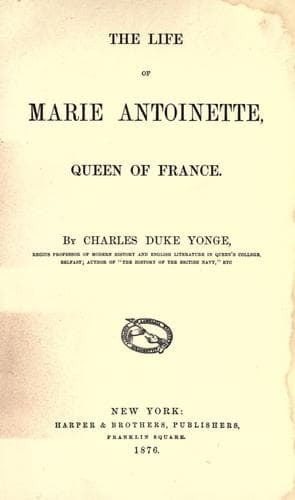
The Life of Marie Antoinette, Queen of France — John Shaqi
The Life of Marie Antoinette, Queen of FranceYonge, Charles Duke
History
The Life of Marie Antoinette, Queen of France
Yonge, Charles Duke
Marie Antoinette, Queen, consort of Louis XVI, King of France, 1755-1793
Not that the intrigues of the mistress and her adherents were at all
diminished. They were even more active than ever since the marriage of the
Count de Provence, who, in an underhanded way, instigated his wife to show
countenance to Madame du Barri, and who allowed, if he did not encourage,
the mistress and her friends to speak slightingly of the dauphiness in his
presence. But, as Marie Antoinette felt firmer in her own position, she
could afford to disregard the malice of these caballers more than she had
felt that she could do at first, and even to defy them. On one occasion
that the Count de Provence was imprudent enough to discuss some of his
schemes with the door open while she was in the next room, she told him
frankly that she had heard all that he said, and reproached him for his
duplicity; and the dauphin coming in at the moment, she flew to him,
throwing her arms round his neck, and telling him how she appreciated his
honesty and candor, and how the more she compared him with the others, the
more she saw his superiority. Indeed, she soon began to find that the
Countess de Provence was as little to be trusted as her husband; and the
only member of the family whom she really liked, or of whom she had at all
a favorable opinion, was the Count d'Artois, who, though not yet out of
the school-room, "showed," as she told her mother, "sentiments of honesty
which he could never have learned of his governor.[8]"
Her indefatigable guardian, Mercy, reported to the empress that she
improved every day. He had learned to conceive a very high idea of her
abilities; and he dilated with especial satisfaction on the powers of
conversation which she was developing; on her wit and readiness in
repartee; on her originality, as well as facility of expression; and on
her perfect possession of the royal art of speaking to a whole company
with such notice of each member of it, that each thought himself the
person to whom her remarks were principally addressed. She possessed
another accomplishment, also, of great value to princes--a tenacious
recollection of faces and names. And she had made herself acquainted with
the history of all the chief nobles, so as to be able to make graceful
allusions to facts in their family annals of which they were proud, and,
what was perhaps even more important, to avoid unpleasant or dangerous
topics. The king himself was not insensible to the increase of attraction
which her charms, both of person and manner, conferred on the royal
palace. He was perfectly satisfied with the civility of her behavior to
Madame du Barri, who admitted that she had nothing to complain of. And
the only point in which even Mercy, the most critical of judges, saw any
room for alteration in her conduct was a certain remissness in bestowing
her notice on men of real eminence, and on foreign visitors if they were
not of the very highest rank; the remark as to the latter class being
Public-domain text, read in full here on John Shaqi.
Reviews
Reviews
No reviews yet
Be the first to share your thoughts on this work.
Join the Discussion
Join the discussion
Sign in to leave a comment or review.
Sign InorCreate an account