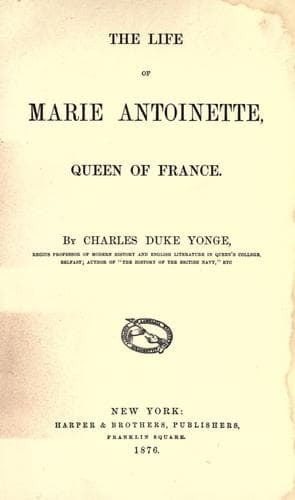
The Life of Marie Antoinette, Queen of FranceYonge, Charles Duke
History
The Life of Marie Antoinette, Queen of France
Yonge, Charles Duke
Marie Antoinette, Queen, consort of Louis XVI, King of France, 1755-1793
occasion they proceeded to acts of personal violence to each other in her
presence. Luckily no one else was by, and she was able to pacify and
reconcile them; but she could hardly avoid feeling ashamed of having been
called on to exert herself in such a cause, or contrasting the undignified
boisterousness (to give it no worse name) of such scenes with the decorous
self-respect which, with all their simplicity of character, had always
governed the conduct of her own relations.
Not but that, in the opinion of Mercy,[1] the dauphin was endowed by
nature with a more than ordinary share of good qualities. His faults were
only such as proceeded from an excessively bad education. He had many most
essential virtues. He was a young man of perfect integrity and
straightforwardness; he was desirous to hear the truth; and it was never
necessary to beat about the bush, or to have recourse to roundabout ways
of bringing it before him. On the contrary, to speak to him with perfect
frankness was the surest way both to win his esteem and to convince his
reason. On one or two occasions in which he had consulted the embassador,
Mercy had expressed his opinions without the least reserve, and had
perceived that the young prince had liked him better for his candor.
The king still kept up the habit of spending the greater part of the
autumn at Compiègne and Fontainebleau, visits which Marie Antoinette
welcomed as a holiday from the etiquette of Versailles. She wrote word to
her mother that she was growing very fast, and taking asses' milk to keep
up her strength; that that regimen, with constant exercise, was doing her
great good; and that she had gained great praise for the excellence of her
riding. On one occasion, when they were at Fontainebleau, she especially
delighted the officers of her husband's regiment of cuirassiers, when the
king reviewed it in person. The dauphin himself took the command of his
men, and put them through their evolutions while she rode by his side; he
then presented each of the officers to her separately, and she distributed
cockades to the whole body. The first she gave to the dauphin himself,[2]
who placed it in his hat. Each officer, as he received his, did the same.
And after the king had taken his departure, she, with her husband,
remained on the field for an hour, conversing freely with the soldiers,
and showing the greatest interest in all that concerned the regiment.
Throughout the day the young prince had exhibited a knowledge of the
profession, and a readiness as well as an ease of manner, which had
surprised all the spectators, and Mercy had the satisfaction of hearing
every one attribute the admirable appearance which he had made on so
important an occasion (for it was the first time of his appearing in such
a position) to the example and hints of the dauphiness.
Public-domain text, read in full here on John Shaqi.
Reviews
Reviews
No reviews yet
Be the first to share your thoughts on this work.
Join the Discussion
Join the discussion
Sign in to leave a comment or review.
Sign InorCreate an account