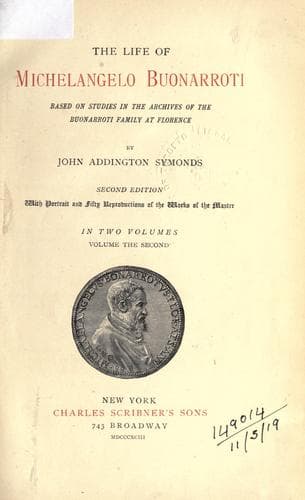
The Life of Michelangelo BuonarrotiSymonds, John Addington
History
The Life of Michelangelo Buonarroti
Symonds, John Addington
Michelangelo Buonarroti, 1475-1564
When he was an old man, Michelangelo told Condivi that Pope Leo
changed his mind about S. Lorenzo. In the often-quoted letter to the
prelate he said: "Leo, not wishing me to work at the tomb of Julius,
_pretended that he wanted to complete_ the façade of S. Lorenzo at
Florence." What was the real state of the case can only be
conjectured. It does not seem that the Pope took very kindly to the
façade; so the project may merely have been dropped through
carelessness. Michelangelo neglected his own interests by not going to
Rome, where his enemies kept pouring calumnies into the Pope's ears.
The Marquis of Carrara, as reported by Lionardo, wrote to Leo that "he
had sought to do you honour, and had done so to his best ability. It
was your fault if he had not done more--the fault of your sordidness,
your quarrelsomeness, your eccentric conduct." When, then, a dispute
arose between the Cardinal and the sculptor about the marbles, Leo may
have felt that it was time to break off from an artist so impetuous
and irritable. Still, whatever faults of temper Michelangelo may have
had, and however difficult he was to deal with, nothing can excuse the
Medici for their wanton waste of his physical and mental energies at
the height of their development.
On the 6th of April 1520 Raffaello died, worn out with labour and with
love, in the flower of his wonderful young manhood. It would be rash
to assert that he had already given the world the best he had to
offer, because nothing is so incalculable as the evolution of genius.
Still we perceive now that his latest manner, both as regards style
and feeling, and also as regards the method of execution by
assistants, shows him to have been upon the verge of intellectual
decline. While deploring Michelangelo's impracticability--that
solitary, self-reliant, and exacting temperament which made him reject
collaboration, and which doomed so much of his best work to
incompleteness--we must remember that to the very end of his long life
he produced nothing (except perhaps in architecture) which does not
bear the seal and superscription of his fervent self. Raffaello, on
the contrary, just before his death, seemed to be exhaling into a
nebulous mist of brilliant but unsatisfactory performances. Diffusing
the rich and facile treasures of his genius through a host of lesser
men, he had almost ceased to be a personality. Even his own work, as
proved by the Transfiguration, was deteriorating. The blossom was
overblown, the bubble on the point of bursting; and all those pupils
who had gathered round him, drawing like planets from the sun their
lustre, sank at his death into frigidity and insignificance. Only
Giulio Romano burned with a torrid sensual splendour all his own.
Fortunately for the history of the Renaissance, Giulio lived to evoke
the wonder of the Mantuan villa, that climax of associated crafts of
decoration, which remains for us the symbol of the dream of art
indulged by Raffaello in his Roman period.
Public-domain text, read in full here on John Shaqi.
Reviews
Reviews
No reviews yet
Be the first to share your thoughts on this work.
Elsewhere in the archive
Join the Discussion
Join the discussion
Sign in to leave a comment or review.
Sign InorCreate an account