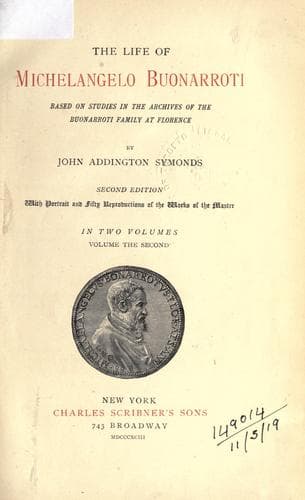
The Life of Michelangelo BuonarrotiSymonds, John Addington
History
The Life of Michelangelo Buonarroti
Symonds, John Addington
Michelangelo Buonarroti, 1475-1564
in the same way while negotiating with princes.
IX
When Michelangelo complained that he was "rovinato per detta opera di
San Lorenzo," he probably did not mean that he was ruined in purse,
but in health and energy. For some while after Leo gave him his
liberty, he seems to have remained comparatively inactive. During this
period the sacristy at S. Lorenzo and the Medicean tombs were probably
in contemplation. Giovanni Cambi says that they were begun at the end
of March 1520. But we first hear something definite about them in a
_Ricordo_ which extends from April 9 to August 19, 1521. Michelangelo
says that on the former of these dates he received money from the
Cardinal de' Medici for a journey to Carrara, whither he went and
stayed about three weeks, ordering marbles for "the tombs which are to
be placed in the new sacristy at S. Lorenzo. And there I made out
drawings to scale, and measured models in clay for the said tombs." He
left his assistant Scipione of Settignano at Carrara as overseer of
the work and returned to Florence. On the 20th of July following he
went again to Carrara, and stayed nine days. On the 16th of August the
contractors for the blocks, all of which were excavated from the old
Roman quarry of Polvaccio, came to Florence, and were paid for on
account. Scipione returned on the 19th of August. It may be added that
the name of Stefano, the miniaturist, who acted as Michelangelo's
factotum through several years, is mentioned for the first time in
this minute and interesting record.
That the commission for the sacristy came from the Cardinal Giulio,
and not from the Pope, appears in the document I have just cited. The
fact is confirmed by a letter written to Fattucci in 1523: "About two
years have elapsed since I returned from Carrara, whither I had gone
to purchase marbles for the tombs of the Cardinal." The letter is
curious in several respects, because it shows how changeable through
many months Giulio remained about the scheme; at one time bidding
Michelangelo prepare plans and models, at another refusing to listen
to any proposals; then warming up again, and saying that, if he lived
long enough, he meant to erect the façade as well. The final issue of
the affair was, that after Giulio became Pope Clement VII., the
sacristy went forward, and Michelangelo had to put the sepulchre of
Julius aside. During the pontificate of Adrian, we must believe that
he worked upon his statues for that monument, since a Cardinal was
hardly powerful enough to command his services; but when the Cardinal
became Pope, and threatened to bring an action against him for moneys
received, the case was altered. The letter to Fattucci, when carefully
studied, leads to these conclusions.
Very little is known to us regarding his private life in the year
1521. We only possess one letter, relating to the purchase of a house.
In October he stood godfather to the infant son of Niccolò Soderini,
nephew of his old patron, the Gonfalonier.
Public-domain text, read in full here on John Shaqi.
Reviews
Reviews
No reviews yet
Be the first to share your thoughts on this work.
Elsewhere in the archive
Join the Discussion
Join the discussion
Sign in to leave a comment or review.
Sign InorCreate an account