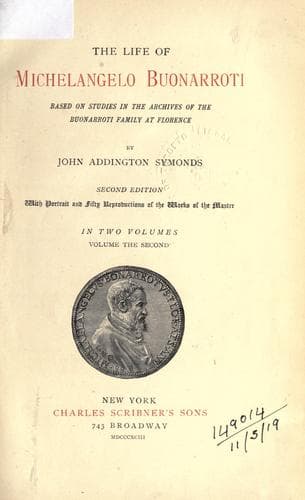
The Life of Michelangelo BuonarrotiSymonds, John Addington
History
The Life of Michelangelo Buonarroti
Symonds, John Addington
Michelangelo Buonarroti, 1475-1564
This barren period is marked by only one considerable event--that is,
the termination of the Cristo Risorto, or Christ Triumphant, which had
been ordered by Metello Varj de' Porcari in 1514. The statue seems to
have been rough-hewn at the quarries, packed up, and sent to Pisa on
its way to Florence as early as December 1518, but it was not until
March 1521 that Michelangelo began to occupy himself about it
seriously. He then despatched Pietro Urbano to Rome with orders to
complete it there, and to arrange with the purchaser for placing it
upon a pedestal. Sebastiano's letters contain some references to this
work, which enable us to understand how wrong it would be to accept it
as a representative piece of Buonarroti's own handicraft. On the 9th
of November 1520 he writes that his gossip, Giovanni da Reggio, "goes
about saying that you did not execute the figure, but that it is the
work of Pietro Urbano. Take good care that it should be seen to be
from your hand, so that poltroons and babblers may burst." On the 6th
of September 1521 he returns to the subject. Urbano was at this time
resident in Rome, and behaving himself so badly, in Sebastiano's
opinion, that he feels bound to make a severe report. "In the first
place, you sent him to Rome with the statue to finish and erect it.
What he did and left undone you know already. But I must inform you
that he has spoiled the marble wherever he touched it. In particular,
he shortened the right foot and cut the toes off; the hands too,
especially the right hand, which holds the cross, have been mutilated
in the fingers. Frizzi says they seem to have been worked by a
biscuit-maker, not wrought in marble, but kneaded by some one used to
dough. I am no judge, not being familiar with the method of
stone-cutting; but I can tell you that the fingers look to me very
stiff and dumpy. It is clear also that he has been peddling at the
beard; and I believe my little boy would have done so with more sense,
for it looks as though he had used a knife without a point to chisel
the hair. This can easily be remedied, however. He has also spoiled
one of the nostrils. A little more, and the whole nose would have been
ruined, and only God could have restored it." Michelangelo apparently
had already taken measures to transfer the Christ from Urbano's hands
to those of the sculptor Federigo Frizzi. This irritated his former
friend and workman. "Pietro shows a very ugly and malignant spirit
after finding himself cast off by you. He does not seem to care for
you or any one alive, but thinks he is a great master. He will soon
find out his mistake, for the poor young man will never be able to
make statues. He has forgotten all he knew of art, and the knees of
your Christ are worth more than all Rome together." It was
Sebastiano's wont to run babbling on this way. Once again he returns
to Pietro Urbano. "I am informed that he has left Rome; he has not
been seen for several days, has shunned the Court, and I certainly
Public-domain text, read in full here on John Shaqi.
Reviews
Reviews
No reviews yet
Be the first to share your thoughts on this work.
Elsewhere in the archive
Join the Discussion
Join the discussion
Sign in to leave a comment or review.
Sign InorCreate an account