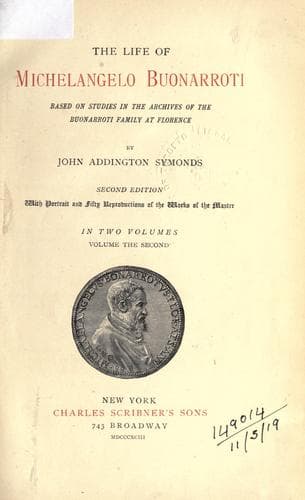
The Life of Michelangelo BuonarrotiSymonds, John Addington
History
The Life of Michelangelo Buonarroti
Symonds, John Addington
Michelangelo Buonarroti, 1475-1564
Clement, immediately after his election, resolved on setting
Michelangelo at work in earnest on the Sacristy. At the very beginning
of January he also projected the building of the Laurentian Library,
and wrote, through his Roman agent, Giovanni Francesco Fattucci,
requesting to have two plans furnished, one in the Greek, the other in
the Latin style. Michelangelo replied as follows: "I gather from your
last that his Holiness our Lord wishes that I should furnish the
design for the library. I have received no information, and do not
know where it is to be erected. It is true that Stefano talked to me
about the scheme, but I paid no heed. When he returns from Carrara I
will inquire, and will do all that is in my power, _albeit
architecture is not my profession_." There is something pathetic in
this reiterated assertion that his real art was sculpture. At the same
time Clement wished to provide for him for life. He first proposed
that Buonarroti should promise not to marry, and should enter into
minor orders. This would have enabled him to enjoy some ecclesiastical
benefice, but it would also have handed him over firmly bound to the
service of the Pope. Circumstances already hampered him enough, and
Michelangelo, who chose to remain his own master, refused. As Berni
wrote: "Voleva far da se, non comandato." As an alternative, a pension
was suggested. It appears that he only asked for fifteen ducats a
month, and that his friend Pietro Gondi had proposed twenty-five
ducats. Fattucci, on the 13th of January 1524, rebuked him in
affectionate terms for his want of pluck, informing him that "Jacopo
Salviati has given orders that Spina should be instructed to pay you a
monthly provision of fifty ducats." Moreover, all the disbursements
made for the work at S. Lorenzo were to be provided by the same agent
in Florence, and to pass through Michelangelo's hands. A house was
assigned him, free of rent, at S. Lorenzo, in order that he might be
near his work. Henceforth he was in almost weekly correspondence with
Giovanni Spina on affairs of business, sending in accounts and drawing
money by means of his then trusted servant, Stefano, the miniaturist.
Public-domain text, read in full here on John Shaqi.
Reviews
Reviews
No reviews yet
Be the first to share your thoughts on this work.
Elsewhere in the archive
Join the Discussion
Join the discussion
Sign in to leave a comment or review.
Sign InorCreate an account