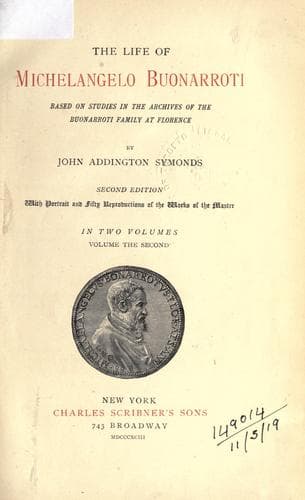
The Life of Michelangelo BuonarrotiSymonds, John Addington
History
The Life of Michelangelo Buonarroti
Symonds, John Addington
Michelangelo Buonarroti, 1475-1564
That Stefano did not always behave himself according to his master's
wishes appears from the following characteristic letter addressed by
Michelangelo to his friend Pietro Gondi: "The poor man, who is
ungrateful, has a nature of this sort, that if you help him in his
needs, he says that what you gave him came out of superfluities; if
you put him in the way of doing work for his own good, he says you
were obliged, and set him to do it because you were incapable; and all
the benefits which he received he ascribes to the necessities of the
benefactor. But when everybody can see that you acted out of pure
benevolence, the ingrate waits until you make some public mistake,
which gives him the opportunity of maligning his benefactor and
winning credence, in order to free himself from the obligation under
which he lies. This has invariably happened in my case. No one ever
entered into relations with me--I speak of workmen--to whom I did not
do good with all my heart. Afterwards, some trick of temper, or some
madness, which they say is in my nature, which hurts nobody except
myself, gives them an excuse for speaking evil of me and calumniating
my character. Such is the reward of all honest men."
These general remarks, he adds, apply to Stefano, whom he placed in a
position of trust and responsibility, in order to assist him. "What I
do is done for his good, because I have undertaken to benefit the man,
and cannot abandon him; but let him not imagine or say that I am doing
it because of my necessities, for, God be praised, I do not stand in
need of men." He then begs Gondi to discover what Stefano's real mind
is. This is a matter of great importance to him for several reasons,
and especially for this: "If I omitted to justify myself, and were to
put another in his place, I should be published among the Piagnoni for
the biggest traitor who ever lived, even though I were in the right."
We conclude, then, that Michelangelo thought of dismissing Stefano,
but feared lest he should get into trouble with the powerful political
party, followers of Savonarola, who bore the name of Piagnoni at
Florence. Gondi must have patched the quarrel up, for we still find
Stefano's name in the _Ricordi_ down to April 4, 1524. Shortly after
that date, Antonio Mini seems to have taken his place as
Michelangelo's right-hand man of business. These details are not so
insignificant as they appear. They enable us to infer that the
Sacristy of S. Lorenzo may have been walled and roofed in before the
end of April 1524; for, in an undated letter to Pope Clement,
Michelangelo says that Stefano has finished the lantern, and that it
is universally admired. With regard to this lantern, folk told him
that he would make it better than Brunelleschi's. "Different perhaps,
but better, no!" he answered. The letter to Clement just quoted is
interesting in several respects. The boldness of the beginning makes
one comprehend how Michelangelo was terrible even to Popes:--
Public-domain text, read in full here on John Shaqi.
Reviews
Reviews
No reviews yet
Be the first to share your thoughts on this work.
Elsewhere in the archive
Join the Discussion
Join the discussion
Sign in to leave a comment or review.
Sign InorCreate an account