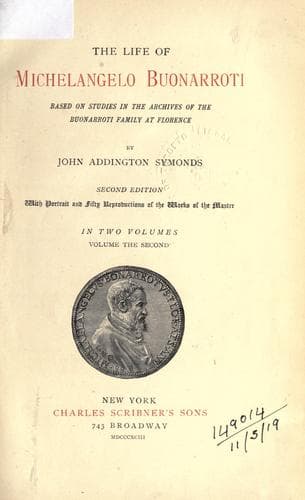
The Life of Michelangelo BuonarrotiSymonds, John Addington
History
The Life of Michelangelo Buonarroti
Symonds, John Addington
Michelangelo Buonarroti, 1475-1564
Another, blurred and indistinct,
with clumsy architectural environment, exhibits two of these
allegories, arranged much as we now see them at S. Lorenzo. A
river-god, recumbent beneath the feet of a female statue, carries the
eye down to the ground, and enables us to comprehend how these
subordinate figures were wrought into the complex harmony of flowing
lines he had imagined. The seventh study differs in conception from
the rest; it stands alone. There are four handlings of what begins
like a huge portal, and is gradually elaborated into an architectural
scheme containing three great niches for statuary. It is powerful and
simple in design, governed by semicircular arches--a feature which is
absent from the rest.
All these drawings are indubitably by the hand of Michelangelo, and
must be reckoned among his first free efforts to construct a working
plan. The Albertina Collection at Vienna yields us an elaborate design
for the sacristy, which appears to have been worked up from some of
the rougher sketches. It is executed in pen, shaded with bistre, and
belongs to what I have ventured to describe as office work. It may
have been prepared for the inspection of Leo and the Cardinal. Here we
have the sarcophagi in pairs, recumbent figures stretched upon a
shallow curve inverted, colossal orders of a bastard Ionic type, a
great central niche framing a seated Madonna, two male figures in side
niches, suggestive of Giuliano and Lorenzo as they were at last
conceived, four allegorical statues, and, to crown the whole
structure, candelabra of a peculiar shape, with a central round,
supported by two naked genii. It is difficult, as I have before
observed, to be sure how much of the drawings executed in this way can
be ascribed with safety to Michelangelo himself. They are carefully
outlined, with the precision of a working architect; but the
sculptural details bear the aspect of what may be termed a generic
Florentine style of draughtsmanship.
Public-domain text, read in full here on John Shaqi.
Reviews
Reviews
No reviews yet
Be the first to share your thoughts on this work.
Elsewhere in the archive
Join the Discussion
Join the discussion
Sign in to leave a comment or review.
Sign InorCreate an account